
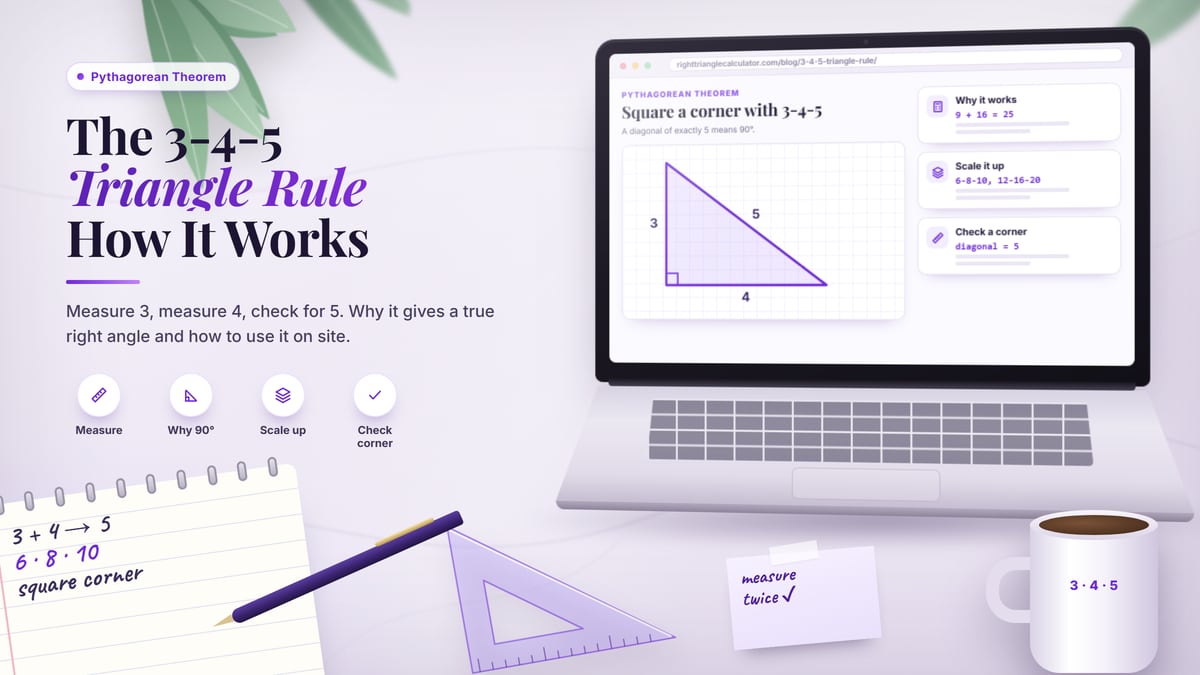
A 3 4 5 triangle is a right triangle, and you can prove it in one line: 3² + 4² = 9 + 16 = 25, and 5² = 25, so 3² + 4² = 5². Because the three sides satisfy the Pythagorean relationship exactly, the angle opposite the side of length 5 is exactly 90°. That single fact is the whole 3-4-5 rule: measure 3 units along one edge, 4 units along the other, and if the distance between those two marks is exactly 5 units, the corner between them is square.
Figure 1
Why 3-4-5 produces exactly 90°
Most people meet the Pythagorean theorem in its forward form: in a right triangle, a² + b² = c². The 3-4-5 rule runs that statement backwards, and the backwards version is a separate theorem with its own proof.
The converse of the Pythagorean theorem: if the three sides of a triangle satisfy a² + b² = c², then the triangle is a right triangle, and the right angle is the one opposite side c.
The converse is what licenses the 3-4-5 method. Without it, matching side lengths would prove nothing about the angle.
The converse matters because a layout tape can only measure lengths, never angles. You cannot put a protractor on a foundation corner and read 90° to any useful precision. But you can measure three distances accurately, and the converse turns those three distances into a guarantee about the angle. Nothing about the method is an approximation or a rule of thumb. If the three measurements are exact, the angle is exactly 90°.
Be precise about what the converse does not say. It does not say 3-4-5 is the only integer triple that works. Any set of whole numbers satisfying a² + b² = c² does the same job, and there are infinitely many of them. The full family is covered in the guide to Pythagorean triples. 3-4-5 is simply the smallest, which is why it is the one everyone memorises.
A useful way to see the arithmetic
Write the squares as areas. A square built on the side of length 3 covers 9 square units. A square on the side of length 4 covers 16. Together that is 25 square units, which is exactly the area of a square built on the side of length 5. The two smaller squares tile the larger one with nothing left over and nothing missing, and that exact fit is what forces the angle to be 90° rather than 89° or 91°.
The exact angles: 36.87° and 53.13°
The 3-4-5 triangle has one right angle and two fixed acute angles. They are not round numbers, and unlike the 30-60-90 or 45-45-90 triangles they are not expressible with a simple radical. To more decimal places:
- Angle opposite the side of length 3: arctan(3/4) = 36.8698976°, usually rounded to 36.87° (36° 52′ to the nearest arcminute)
- Angle opposite the side of length 4: arctan(4/3) = 53.1301024°, usually rounded to 53.13° (53° 8′)
- Right angle opposite the side of length 5: 90°
Check: 36.8698976 + 53.1301024 = 90.0000000, as the two acute angles of any right triangle must.
The trig ratios come out unusually clean even though the angles do not:
| Ratio | Value | Angle |
|---|---|---|
| sin 36.87° | 3/5 = 0.6 | opposite 3, hypotenuse 5 |
| cos 36.87° | 4/5 = 0.8 | adjacent 4, hypotenuse 5 |
| tan 36.87° | 3/4 = 0.75 | opposite 3, adjacent 4 |
| sin 53.13° | 4/5 = 0.8 | opposite 4, hypotenuse 5 |
| cos 53.13° | 3/5 = 0.6 | adjacent 3, hypotenuse 5 |
| tan 53.13° | 4/3 ≈ 1.3333 | opposite 4, adjacent 3 |
This is why 3-4-5 shows up so often in textbook trigonometry: it is the smallest right triangle whose sine and cosine are terminating decimals.
Area and perimeter of the base triangle
Because the two legs meet at the right angle, they are the base and the height, so the area needs no extra work:
Area and perimeter of the base 3-4-5 triangle.
A quiet curiosity: the perimeter, 12, is exactly twice the area, 6. Search every right triangle with whole-number sides and the 3-4-5 is the only one for which that holds.
Two other quantities fall out of the same numbers. The altitude drawn to the hypotenuse is 3 à - 4 / 5 = 2.4 units, and the radius of the inscribed circle is (3 + 4 − 5) / 2 = 1 unit exactly.
Scaling: every multiple of 3-4-5 works
Multiply all three sides by the same number and the relationship survives, because both sides of the equation are multiplied by the square of that number. If a² + b² = c², then (ka)² + (kb)² = k²a² + k²b² = k²c² = (kc)². So the scaled triangle is still a right triangle.
| Multiple | Sides | Check | Acute angles | Area | Perimeter |
|---|---|---|---|---|---|
| à - 1 | 3, 4, 5 | 9 + 16 = 25 | 36.87°, 53.13° | 6 | 12 |
| à - 2 | 6, 8, 10 | 36 + 64 = 100 | 36.87°, 53.13° | 24 | 24 |
| à - 3 | 9, 12, 15 | 81 + 144 = 225 | 36.87°, 53.13° | 54 | 36 |
| à - 4 | 12, 16, 20 | 144 + 256 = 400 | 36.87°, 53.13° | 96 | 48 |
| à - 5 | 15, 20, 25 | 225 + 400 = 625 | 36.87°, 53.13° | 150 | 60 |
| à - 10 | 30, 40, 50 | 900 + 1600 = 2500 | 36.87°, 53.13° | 600 | 120 |
The angles are identical down the whole column, and that is not a coincidence either. Scaling every side by the same factor produces a similar triangle, and similar triangles have equal corresponding angles by definition. Angles depend on the ratios of the sides, and scaling leaves every ratio untouched: 6/8 and 12/16 both reduce to 3/4, so both give arctan(3/4) = 36.87°.
Note what does not scale the same way. Perimeter scales with k (doubling the sides doubles the perimeter from 12 to 24), but area scales with k² (doubling the sides quadruples the area from 6 to 24).
Figure 2
How to square a corner with the 3-4-5 rule
The layout procedure is the converse applied with a tape measure.
- Mark the corner point where the two edges are supposed to meet at 90°.
- From that corner, measure 3 units along the first edge and mark it.
- From the same corner, measure 4 units along the second edge and mark it.
- Measure the straight-line distance between the two marks. This is the diagonal, and it plays the role of the hypotenuse.
- If the diagonal reads exactly 5 units, the corner is exactly 90°. If it does not, swing the second edge until it does.
Figure 3
Reading the diagonal when it is wrong
The diagonal is a direct readout of the corner angle, and the direction of the error tells you which way to move.
- Diagonal too long means the corner is open wider than 90°. Pulling the two marks further apart can only happen by opening the angle between them.
- Diagonal too short means the corner is less than 90°, pinched closed.
- Diagonal exactly 5 means exactly 90°.
The underlying relationship is the law of cosines, which is the general form the Pythagorean theorem is a special case of:
When C = 90°, cos(C) = 0 and the last term vanishes, leaving c² = a² + b².
With a = 3 and b = 4, cos(C) = (25 − c²) / 24. When c is larger than 5, the numerator goes negative, cos(C) goes negative, and C exceeds 90°. When c is smaller than 5, cos(C) is positive and C falls below 90°.
Work at the largest scale that fits
A 3 ft, 4 ft, 5 ft triangle is easy to lay out but it is a poor measuring instrument, because a small absolute error in a short diagonal is a large relative error. Using 6-8-10 or 12-16-20 over a longer run fixes this. Here is the same 1/8 inch mistake on the diagonal, at three scales:
| Triangle (feet) | Diagonal reads | Actual corner angle | Error |
|---|---|---|---|
| 3-4-5 | 5 ft + 1/8 in | 90.2489° | 0.2489° (about 14.9 arcminutes) |
| 6-8-10 | 10 ft + 1/8 in | 90.1244° | 0.1244° (about 7.5 arcminutes) |
| 12-16-20 | 20 ft + 1/8 in | 90.0622° | 0.0622° (about 3.7 arcminutes) |
Doubling the triangle halves the angular error; quadrupling it quarters the error. The reason is geometric rather than lucky. The angular effect of a diagonal error is roughly the error divided by the length of the sides, so a fixed 1/8 inch spread over a 20 ft diagonal tilts the corner four times less than the same 1/8 inch spread over a 5 ft diagonal.
That angular error compounds along the wall. A 0.2489° error means that 24 ft from the corner, the line is 1.25 inches off where it should be. The 12-16-20 version of the same mistake leaves you 0.31 inches off at the same 24 ft. Same tape, same care, four times the accuracy, purely from choosing bigger numbers.
Units: any unit works, as long as it is one unit
The rule is about ratios, not about a particular measuring system. 3, 4 and 5 feet works. So does 3, 4 and 5 metres, 3, 4 and 5 inches, or 30, 40 and 50 centimetres. What breaks the method is mixing units inside one triangle.
Imperial example. Legs of 6 ft and 8 ft need a diagonal of exactly 10 ft. Check: 6² + 8² = 36 + 64 = 100 = 10². Convert everything to inches and it still holds: 72² + 96² = 5184 + 9216 = 14400 = 120².
Metric example. Legs of 0.9 m and 1.2 m need a diagonal of exactly 1.5 m, which is the 3-4-5 scaled by 0.3. Check: 0.9² + 1.2² = 0.81 + 1.44 = 2.25 = 1.5². In centimetres: 90² + 120² = 8100 + 14400 = 22500 = 150². Larger metric version: 2.4 m and 3.2 m call for a 4.0 m diagonal.
The scale factor does not have to be a whole number. 1.5-2-2.5, 0.9-1.2-1.5 and 7.5-10-12.5 are all genuine right triangles.
Worked examples
Problem 1 Confirm the triple
- Given
- Sides 3, 4 and 5
- Find
- Whether the triangle has a right angle
- Formula
- a² + b² = c² (converse)
- Substitution
- 3² + 4² vs 5²
- Calculation
- 9 + 16 = 25 and 5² = 25
Answer Yes, right angle opposite the side of length 5
Problem 2 Find the diagonal from two legs
- Given
- Legs of 3 m and 4 m meeting at 90°
- Find
- The hypotenuse
- Formula
- c = √(a² + b²)
- Substitution
- c = √(3² + 4²)
- Calculation
- c = √(9 + 16) = √25
Answer 5 m
Problem 3 Find a missing leg
- Given
- Hypotenuse 25 cm, one leg 15 cm
- Find
- The other leg
- Formula
- b = √(c² − a²)
- Substitution
- b = √(25² − 15²)
- Calculation
- b = √(625 − 225) = √400
Answer 20 cm, so the triangle is 15-20-25, the 3-4-5 scaled by 5
Problem 4 Is 21-28-35 a right triangle?
- Given
- Sides 21, 28 and 35
- Find
- Whether it is a 3-4-5 multiple
- Formula
- Divide each side by the smallest, or test a² + b² = c²
- Substitution
- 21² + 28² vs 35²
- Calculation
- 441 + 784 = 1225 and 35² = 1225
Answer Yes. It is 3-4-5 scaled by 7, with angles 36.87° and 53.13°
Problem 5 Squaring a deck corner in feet
- Given
- A deck corner; 6 ft marked along one edge and 8 ft along the other from the same point
- Find
- The diagonal that makes the corner exactly 90°
- Formula
- c = √(a² + b²)
- Substitution
- c = √(6² + 8²)
- Calculation
- c = √(36 + 64) = √100
Answer Exactly 10 ft (6-8-10 is the 3-4-5 doubled)
Problem 6 Setting a gate post in metres
- Given
- 1.2 m marked along the fence line and 0.9 m out to the post position
- Find
- The required diagonal
- Formula
- c = √(a² + b²)
- Substitution
- c = √(0.9² + 1.2²)
- Calculation
- c = √(0.81 + 1.44) = √2.25
Answer 1.50 m exactly
Problem 7 The diagonal came out too long
- Given
- Legs of 9 ft and 12 ft; the diagonal measures 15 ft 3 in = 15.25 ft instead of 15 ft
- Find
- The actual corner angle
- Formula
- cos(C) = (a² + b² − c²) / (2ab)
- Substitution
- cos(C) = (81 + 144 − 232.5625) / (2 à - 9 à - 12)
- Calculation
- cos(C) = −7.5625 / 216 = −0.035012, so C = arccos(−0.035012)
Answer 92.01°, so the corner is about 2° too open and the 12 ft edge must swing in
Problem 8 Area and perimeter of a scaled triple
- Given
- A right triangle with legs 24 and 32 units
- Find
- Hypotenuse, area and perimeter
- Formula
- c = √(a² + b²), Area = ½ab, P = a + b + c
- Substitution
- c = √(576 + 1024), Area = ½ à - 24 à - 32
- Calculation
- c = √1600 = 40, Area = 384, P = 24 + 32 + 40
Answer c = 40, area 384 square units, perimeter 96 units (3-4-5 scaled by 8)
Problem 9 Finding the acute angles from the sides
- Given
- A 3-4-5 triangle
- Find
- Both acute angles to two decimal places
- Formula
- θ = arctan(opposite / adjacent)
- Substitution
- θ₠= arctan(3/4) = arctan(0.75), θ₂ = arctan(4/3)
- Calculation
- θ₠= 36.8698976°, θ₂ = 53.1301024°, sum = 90°
Answer 36.87° and 53.13°
Every one of these can be checked in seconds with the right triangle calculator on the homepage: enter two sides and it returns the third side, both acute angles, the area and the perimeter. For longer scenario-style questions built on the same theorem, see Pythagorean theorem word problems.
Common mistakes
Treating 3-4-5 as the only right triangle
3-4-5 is one triple among infinitely many. 5-12-13, 8-15-17, 7-24-25 and 20-21-29 are all primitive triples with the same guarantee and different angles. If the space you are working in suits 5-12-13 better than 6-8-10, use it. The converse does not care which triple you pick.
Assuming any three consecutive integers work
This is the most common misreading of the rule. 3, 4, 5 happen to be consecutive, but consecutiveness is irrelevant. Test 4-5-6:
4² + 5² = 16 + 25 = 41, while 6² = 36.
41 is not 36, so 4-5-6 is not a right triangle. Applying the law of cosines, the angle opposite the side of length 6 is arccos((41 − 36) / 40) = arccos(0.125) = 82.82°, nearly 7° short of square. Running the same test on other consecutive runs: 2-3-4 gives 13 vs 16 and an angle of 104.48°; 5-6-7 gives 61 vs 49 and 78.46°. Only 3-4-5 lands on 90°.
Measuring both legs from different points
The 3 and the 4 must both start at the corner vertex. Measuring 3 units from the corner and then 4 units from the end of the 3 gives a completely different figure and a meaningless diagonal. Hook the tape on the same point twice.
Mixing units inside one triangle
3 feet and 4 metres do not make a 5-of-anything. Convert everything to a single unit before you square anything. 3 ft and 4 ft need a 5 ft diagonal; 3 m and 4 m need a 5 m diagonal.
Putting the 5 on a leg
The longest side is always the hypotenuse and always sits opposite the right angle. If you mark 4 and 5 along the two edges and expect a 3 diagonal, you are describing a triangle where 5 is a leg, and that triangle has a hypotenuse of √41 ≈ 6.40, not 3.
Rounding the angles and reusing them
36.87° is rounded. Feeding 36.87 back into a sine or tangent for a later step drifts the answer. Keep arctan(3/4) at full precision in the calculator until the final line.
Practice questions
- A right triangle has legs of 30 and 40 units. What is the hypotenuse, and what are the two acute angles?
- A right triangle has a hypotenuse of 45 cm and one leg of 27 cm. Find the other leg and identify the scale factor from 3-4-5.
- You mark 4.5 m and 6 m along two edges from a corner. What diagonal makes the corner exactly 90°?
- Is a triangle with sides 6, 7 and 8 a right triangle? Show the arithmetic.
- A 3-4-5 triangle is scaled so that its perimeter is 60 units. What are its side lengths and its area?
- The base 3-4-5 is scaled up by 6. By what factor does the area increase?
Answer key
- c = √(30² + 40²) = √(900 + 1600) = √2500 = 50. The angles are unchanged from the base triple: 36.87° and 53.13° (3-4-5 scaled by 10).
- b = √(45² − 27²) = √(2025 − 729) = √1296 = 36. Sides 27-36-45, which is 3-4-5 scaled by 9.
- c = √(4.5² + 6²) = √(20.25 + 36) = √56.25 = 7.5 m (3-4-5 scaled by 1.5).
- 6² + 7² = 36 + 49 = 85, but 8² = 64. 85 ≠64, so no. The angle opposite the 8 is arccos((85 − 64) / 84) = arccos(0.25) = 75.52°.
- The base perimeter is 12, so the scale factor is 60 / 12 = 5. Sides 15, 20, 25; area = ½ à - 15 à - 20 = 150 square units (the base area 6 times 5² = 25).
- Area scales with the square of the scale factor, so 36 times: from 6 to 216 square units.
Frequently Asked Questions
Does the 3-4-5 rule give an exact right angle or an approximation?
Exact. 3² + 4² = 25 and 5² = 25 with no remainder, so by the converse of the Pythagorean theorem the angle opposite the 5 is precisely 90°. Any error in practice comes from the measuring, not from the rule.
Can I use 3-4-5 in metres, feet and inches?
Yes, in any unit you like, as long as all three measurements use the same one. 3-4-5 in feet, 0.9-1.2-1.5 in metres and 30-40-50 in centimetres are all the same triangle at different scales, and all three have the same 36.87° and 53.13° acute angles.
Why does a bigger version like 12-16-20 give a more accurate corner?
Because a fixed measuring error becomes a smaller fraction of a longer diagonal. A 1/8 inch error on a 5 ft diagonal tilts the corner 0.2489°, while the same 1/8 inch on a 20 ft diagonal tilts it only 0.0622°, one quarter as much. Doubling the triangle halves the angular error.
Is 4-5-6 a right triangle since the numbers are consecutive like 3-4-5?
No. 4² + 5² = 41 but 6² = 36, so the converse fails and the angle opposite the 6 is 82.82°, not 90°. Being consecutive has nothing to do with it; 3-4-5 is the only run of three consecutive integers that forms a right triangle.
What should I do if the diagonal does not measure 5?
Swing one edge and re-measure. A diagonal longer than 5 means the corner is open past 90°, so close it; a diagonal shorter than 5 means the corner is under 90°, so open it. If you want the exact angle you currently have, enter the two legs and the measured diagonal into the triangle solver and read the corner angle directly.