
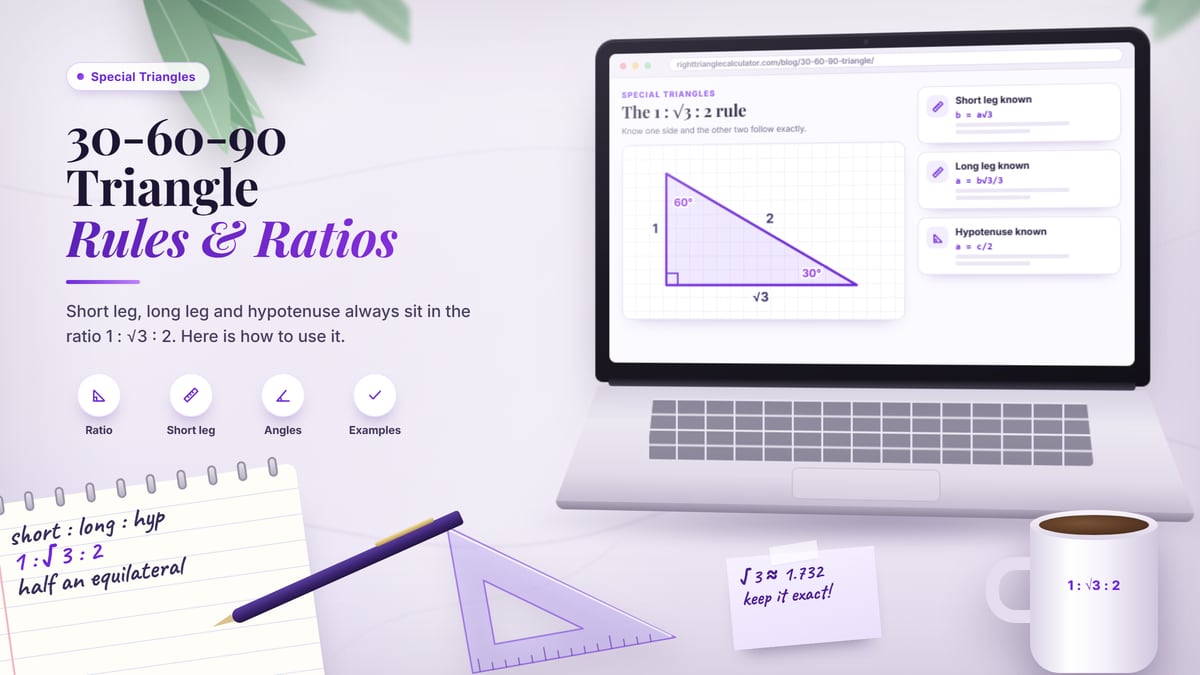
In a 30-60-90 triangle the sides are always in the ratio short leg : long leg : hypotenuse = 1 : √3 : 2. Know any one side and the other two follow with no trigonometry at all: double the short leg for the hypotenuse, multiply the short leg by √3 for the long leg. That single ratio is the whole 30 60 90 triangle rule, and the rest of this page shows why it is true and how to apply it in every direction.
Figure 1
Naming the three sides correctly
Every rule on this page depends on matching each side to its opposite angle, so fix the names first.
- The short leg is opposite the 30° angle. Call it
a. - The long leg is opposite the 60° angle. Call it
b. - The hypotenuse is opposite the 90° angle. Call it
c. It is always the longest side.
The ordering is forced by the angles: bigger angle, longer opposite side. Since 30° is less than 60° is less than 90°, the side facing 30° must be the shortest and the side facing 90° must be the longest. If your working ever produces a “long leg” that is smaller than the short leg, you have swapped two labels.
The 30-60-90 ratio and the two formulas that come straight out of it.
Numerically, √3 ≈ 1.7320508, so the long leg is about 1.73 times the short leg, and the hypotenuse is exactly twice it. A 30-60-90 triangle is noticeably lopsided: the long leg is nearly three quarters of the way to the hypotenuse in length.
A 45-45-90 triangle is the other special right triangle, with the different ratio 1 : 1 : √2; see the 45-45-90 triangle guide for that case, and the special right triangles hub for how the two compare side by side.
Why the 1 : √3 : 2 ratio holds
The ratio is not a convention to memorise. It drops out of an equilateral triangle in two steps.
Start with an equilateral triangle whose sides are all 2 units and whose angles are all 60°. Drop a perpendicular from the top vertex to the base. In an equilateral triangle that perpendicular is also a median and an angle bisector, so it does two things at once: it cuts the 60° vertex angle into two 30° halves, and it cuts the base of 2 into two equal pieces of 1.
Look at just the left half. Its angles are 30° at the top, 60° at the bottom-left, and 90° where the perpendicular meets the base. Its hypotenuse is a full side of the equilateral triangle, so it measures 2. The leg opposite the 30° angle is half the base, so it measures 1. The remaining leg, the perpendicular itself, comes from the Pythagorean theorem:
Bisecting an equilateral triangle of side 2 produces a 30-60-90 triangle with sides 1, √3 and 2.
So the half-triangle has sides 1, √3 and 2 against angles 30°, 60° and 90°. Every 30-60-90 triangle has those same three angles, so every 30-60-90 triangle is similar to this one, and similar triangles have proportional sides. Scale the reference triangle by any factor k and you get sides k, k√3 and 2k, which is still the ratio 1 : √3 : 2. There is no 30-60-90 triangle anywhere that escapes it.
Because the half-triangle is exact, the ratio also hands you the sine and cosine of 30° and 60° for free: sin 30° = 1/2, cos 30° = √3/2, sin 60° = √3/2 and tan 30° = 1/√3. Those values come from the same picture rather than from a calculator, which is why 30-60-90 triangles appear so often in trigonometry exercises. The SOHCAHTOA guide covers how those ratios are set up in general.
How to spot one in a problem
A question rarely says “this is a 30-60-90 triangle”. It gives you something that forces it, and there are four common signals.
- Two angles are stated as 30° and 90°, or 60° and 90°. The third angle fills the gap to 180°, so a right triangle with any one of 30° or 60° is automatically a 30-60-90.
- An equilateral triangle is cut in half by an altitude, a median or an angle bisector, since all three coincide in an equilateral triangle.
- A regular hexagon is split into six equilateral triangles, each of which halves into two 30-60-90 triangles.
- The sides are in the ratio 1 : √3 : 2, sometimes disguised as decimals such as 4, 6.93 and 8. Divide the hypotenuse by the shortest side: if the quotient is 2, the shape is a 30-60-90.
The last test is worth running whenever a problem hands you three sides and asks for the angles. Dividing 8 by 4 gives exactly 2, so the angles are 30°, 60° and 90° without any inverse trig. If the quotient is not 2, the shortcut does not apply and you need the general methods instead.
The three solving cases
Exactly one side is given in most problems, and which side it is decides the arithmetic. There are three cases, and only the middle one needs any care.
Case 1: the short leg is known
This is the easy direction, because the short leg is the “1” in the ratio. Multiply.
Case 1: scale the reference triangle up by the short leg.
Problem 1 Short leg of 7
- Given
- 30-60-90 triangle with short leg a = 7
- Find
- Long leg b and hypotenuse c
- Formula
- b = a√3, c = 2a
- Substitution
- b = 7√3, c = 2 à - 7
- Calculation
- b = 7 à - 1.7320508 ≈ 12.1244, c = 14
Answer b = 7√3 ≈ 12.12, c = 14
Check it against the Pythagorean theorem: 7² + (7√3)² = 49 + 49 à - 3 = 49 + 147 = 196, and 196 = 14². The hypotenuse is the longest of 7, 12.12 and 14, as it must be.
Problem 2 Short leg of 5
- Given
- 30-60-90 triangle with the side opposite 30° equal to 5 cm
- Find
- The other two sides
- Formula
- b = a√3, c = 2a
- Substitution
- b = 5√3, c = 10
- Calculation
- b = 5 à - 1.7320508 ≈ 8.6603
Answer b = 5√3 ≈ 8.66 cm, c = 10 cm
Figure 2
Case 2: the long leg is known
Here you are dividing by √3 rather than multiplying, which is where most errors appear. Work backwards from b = a√3:
Case 2: divide by √3, then rationalise the denominator.
Problem 3 Long leg of 12
- Given
- 30-60-90 triangle with long leg b = 12
- Find
- Short leg a and hypotenuse c
- Formula
- a = b√3 / 3, c = 2a
- Substitution
- a = 12√3 / 3 = 4√3, c = 2 à - 4√3
- Calculation
- a = 4 à - 1.7320508 ≈ 6.9282, c = 8√3 ≈ 13.8564
Answer a = 4√3 ≈ 6.93, c = 8√3 ≈ 13.86
Substituting back: (4√3)² + 12² = 48 + 144 = 192, and (8√3)² = 64 à - 3 = 192. The two match, so the answer is consistent.
Problem 4 Long leg of 9 metres
- Given
- The side facing the 60° angle measures 9 m
- Find
- The short leg and the hypotenuse
- Formula
- a = b√3 / 3, c = 2b√3 / 3
- Substitution
- a = 9√3 / 3 = 3√3, c = 6√3
- Calculation
- a = 3 à - 1.7320508 ≈ 5.1962, c = 6 à - 1.7320508 ≈ 10.3923
Answer a = 3√3 ≈ 5.20 m, c = 6√3 ≈ 10.39 m
Case 3: the hypotenuse is known
The hypotenuse is the “2” in the ratio, so halve it first to recover the short leg, then apply Case 1.
Case 3: halve for the short leg, then multiply that half by √3.
Problem 5 Hypotenuse of 18
- Given
- 30-60-90 triangle with hypotenuse c = 18
- Find
- Both legs
- Formula
- a = c / 2, b = c√3 / 2
- Substitution
- a = 18 / 2 = 9, b = 18√3 / 2 = 9√3
- Calculation
- b = 9 à - 1.7320508 ≈ 15.5885
Answer a = 9, b = 9√3 ≈ 15.59
Figure 3
Notice that all three figures on this page are the same shape at different scales. That is the visual meaning of a fixed ratio. You can confirm any of these results independently with the right triangle calculator by entering one leg and one angle.
Rationalising the denominator
Case 2 produces a fraction with √3 on the bottom, and most courses want that cleared. Multiply the top and bottom by √3, which changes the way the number is written but not its value:
Rationalising: √3 à - √3 = 3, so the radical moves from the denominator to the numerator.
The same move handles the hypotenuse: 2b/√3 = 2b√3/3. Numerically the two forms agree. With b = 12, the unrationalised 12/√3 = 6.9282032 and the rationalised 12√3/3 = 4√3 = 6.9282032. With b = 7, 7/√3 = 4.0414519 and 7√3/3 = 4.0414519.
Rationalising is worth doing even when the mark scheme does not demand it, because the simplified form usually collapses. Dividing 12 by 3 gives the tidy 4√3, whereas 12/√3 hides that simplification. Watch for that cancellation whenever the long leg is a multiple of 3.
Area and perimeter from the short leg
Because both legs are known once the short leg is known, area and perimeter both reduce to a single formula in a.
The legs of a right triangle are its base and height, so the area is half their product:
Area of a 30-60-90 triangle in terms of the short leg a.
The perimeter adds all three sides and factorises:
Perimeter of a 30-60-90 triangle in terms of the short leg a.
Check both with a = 5. The long leg is 5√3 ≈ 8.660254 and the hypotenuse is 10. Adding the sides directly gives 5 + 8.660254 + 10 = 23.660254, and the formula gives 5 à - (3 + 1.7320508) = 5 à - 4.7320508 = 23.660254. The area from ½ à - 5 à - 8.660254 is 21.650635, and the formula gives 25 à - 1.7320508 / 2 = 21.650635. Both agree to every digit shown.
Problem 6 Area from the short leg
- Given
- 30-60-90 triangle with short leg a = 6 cm
- Find
- Area
- Formula
- Area = a²√3 / 2
- Substitution
- Area = 6² à - √3 / 2 = 36√3 / 2
- Calculation
- Area = 18√3 = 18 à - 1.7320508 ≈ 31.1769
Answer 18√3 ≈ 31.18 cm²
Problem 7 Perimeter from the hypotenuse
- Given
- 30-60-90 triangle with hypotenuse c = 14 in
- Find
- Perimeter
- Formula
- a = c / 2, then P = a(3 + √3)
- Substitution
- a = 7, so P = 7(3 + √3) = 21 + 7√3
- Calculation
- P = 21 + 7 à - 1.7320508 = 21 + 12.1244 ≈ 33.1244
Answer 21 + 7√3 ≈ 33.12 in
Reference table of 30-60-90 triangles
Every row below is the same triangle at a different scale. Decimals are rounded to four places at the last step only.
Short leg a (opposite 30°) | Long leg b (opposite 60°) | Hypotenuse c | b as a decimal | c as a decimal |
|---|---|---|---|---|
| 1 | √3 | 2 | 1.7321 | 2 |
| 2 | 2√3 | 4 | 3.4641 | 4 |
| 3 | 3√3 | 6 | 5.1962 | 6 |
| 5 | 5√3 | 10 | 8.6603 | 10 |
| 10 | 10√3 | 20 | 17.3205 | 20 |
Read the table in whichever direction the question gives you. If a problem states a long leg of 5.1962, the third row says the short leg is 3 and the hypotenuse is 6. Unlike the Pythagorean triples such as 3-4-5 and 5-12-13, a 30-60-90 triangle can never have three whole-number sides, because √3 is irrational.
An applied example
30-60-90 triangles show up wherever a 30° slope, a 60° pitch or an equilateral shape is involved.
Problem 8 Access ramp at 30°
- Given
- A ramp climbs at 30° and must reach a doorway 1.2 m above the path
- Find
- Ramp length (hypotenuse) and horizontal run (long leg)
- Formula
- c = 2a, b = a√3
- Substitution
- c = 2 à - 1.2, b = 1.2√3
- Calculation
- c = 2.4, b = 1.2 à - 1.7320508 ≈ 2.0785
Answer Ramp 2.4 m long, run 1.2√3 ≈ 2.08 m
The rise is opposite the 30° angle, so it is the short leg, and the ramp itself is the hypotenuse. A 30° ramp is far too steep for real accessibility standards, but the geometry is the point: at 30°, the sloping length is always exactly twice the height gained.
Problem 9 Height of an equilateral triangle
- Given
- An equilateral triangular sign has sides of 12 cm
- Find
- Its vertical height
- Formula
- Bisect it: short leg = 6, height = 6√3
- Substitution
- height = 6 à - √3
- Calculation
- height = 6 à - 1.7320508 ≈ 10.3923
Answer 6√3 ≈ 10.39 cm
Figure 4
This is the original derivation running in reverse, and it generalises: the height of any equilateral triangle of side s is s√3 / 2.
Common mistakes
Mixing up which leg faces 30°. The most frequent error is multiplying the long leg by √3 instead of dividing it. Ask which angle the given side faces before touching the ratio. A side facing 30° is the small one, so the other sides must come out bigger. A side facing 60° is the middle one, so the short leg must come out smaller and the hypotenuse bigger. If a result breaks that ordering, the labels were swapped.
Forgetting to rationalise. Leaving an answer as 12/√3 is numerically fine, but it hides the simplification. Multiply top and bottom by √3 to get 12√3/3 = 4√3, which is the form most mark schemes expect and the form that makes the next step easier.
Using the ratio on a triangle that is not 30-60-90. The 1 : √3 : 2 rule applies only when the angles really are 30°, 60° and 90°. A right triangle with angles of 32° and 58° looks almost identical on paper but its sides are not in that ratio, and forcing the shortcut will be wrong by a few percent. Confirm both acute angles first, or fall back on sine, cosine and tangent for any other angle pair.
Halving the wrong side. The hypotenuse is double the short leg, never double the long leg. With c = 18 the short leg is 9, not the long leg.
Rounding √3 too early. Using √3 ≈ 1.73 and then scaling gives 5 à - 1.73 = 8.65, while the true value is 8.660254. That drift grows when the rounded figure feeds into an area or a perimeter. Carry the radical symbolically, produce the exact answer such as 5√3, and only then convert to a decimal at the stated precision.
Practice questions
Work these with exact radicals first, then give a decimal to two places. Answers follow.
- A 30-60-90 triangle has a short leg of 9. Find the long leg and the hypotenuse.
- The side opposite the 60° angle is 15. Find the other two sides.
- The hypotenuse is 26. Find both legs.
- Find the area of a 30-60-90 triangle whose short leg is 4 cm.
- The long leg measures 10. Find the short leg and the hypotenuse, rationalised.
- Find the perimeter of a 30-60-90 triangle whose short leg is 8.
Answer key
- Long leg = 9√3 ≈ 15.59, hypotenuse = 18. Check: 9² + (9√3)² = 81 + 243 = 324 = 18².
- Short leg = 15√3/3 = 5√3 ≈ 8.66, hypotenuse = 10√3 ≈ 17.32.
- Short leg = 26/2 = 13, long leg = 13√3 ≈ 22.52.
- Area = 4²√3/2 = 8√3 ≈ 13.86 cm².
- Short leg = 10/√3 = 10√3/3 ≈ 5.77, hypotenuse = 20√3/3 ≈ 11.55.
- P = 8(3 + √3) = 24 + 8√3 ≈ 37.86.
If a figure does not match, re-enter the triangle in the calculator on the homepage and compare the intermediate values rather than only the final one.
Frequently Asked Questions
What is the 30 60 90 triangle rule?
The rule is that the sides are in the ratio 1 : √3 : 2, with the short leg opposite 30°, the long leg opposite 60° and the hypotenuse opposite 90°. In formula form, the long leg equals the short leg times √3, and the hypotenuse equals twice the short leg.
Can a 30-60-90 triangle have all whole-number sides?
No. The long leg is always the short leg multiplied by √3, and √3 is irrational, so if the short leg is a whole number the long leg cannot be. That is the difference between this shape and an integer triple such as 3-4-5, where all three sides are whole numbers.
How do I find the short leg when only the long leg is given?
Divide the long leg by √3, then rationalise: short leg = b√3/3. For b = 21, the short leg is 21√3/3 = 7√3 ≈ 12.12, and the hypotenuse is twice that, 14√3 ≈ 24.25.
Is the hypotenuse always twice the short leg?
Yes, in a 30-60-90 triangle the hypotenuse is exactly twice the side opposite the 30° angle. This follows from the equilateral derivation: the hypotenuse is a full side of the equilateral triangle and the short leg is half of one.
Do I need trigonometry to solve a 30-60-90 triangle?
No. The ratio replaces it entirely for this shape. Trigonometry gives the same answers, since sin 30° = 1/2 and sin 60° = √3/2 encode the same relationships, but multiplying or dividing by √3 is faster and stays exact. For any other angle pair you do need the trig ratios.