
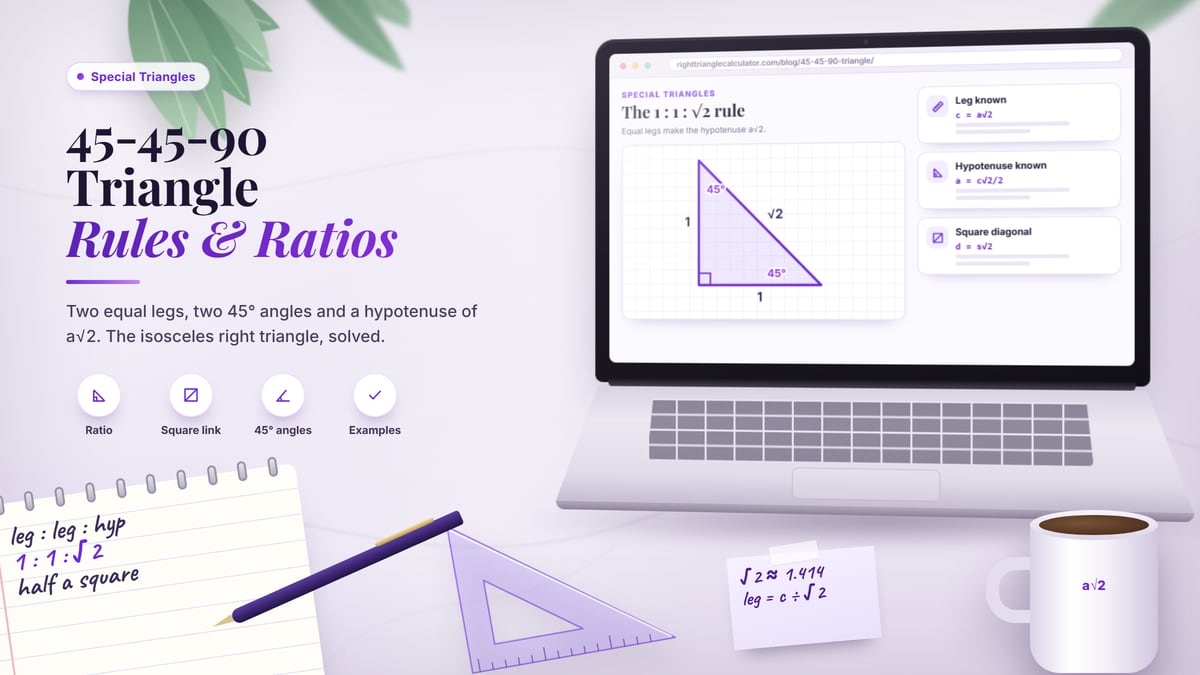
In a 45 45 90 triangle the sides are always in the ratio leg : leg : hypotenuse = 1 : 1 : √2. The two legs are equal, both acute angles measure 45°, and the hypotenuse is exactly √2 times either leg. So if a leg is a, the hypotenuse is a√2, and if the hypotenuse is c, each leg is c√2/2. Those two sentences are the entire 45-45-90 triangle rule; everything below shows where the ratio comes from and how to apply it without a calculator.
Figure 1
Why both legs are equal and both acute angles are 45°
A 45-45-90 triangle is the isosceles right triangle, and the two names describe the same shape from opposite directions.
Start from the angles. The three angles of any triangle sum to 180°. One of them is the right angle, 90°, which leaves 90° to be shared between the two acute angles. If those two angles are equal, each must be 90° ÷ 2 = 45°. There is only one way to split 90° into two equal parts, so the 45-45-90 triangle is the only right triangle with equal acute angles.
Now start from the sides. The base angles theorem says that sides opposite equal angles are equal. The two 45° angles sit opposite the two legs, so the legs are equal. Run the theorem the other way and the same link holds: if the legs of a right triangle are equal, the angles opposite them are equal, and two equal angles adding to 90° are 45° each.
That two-way link is what makes the shape so easy to recognise. Any one of these facts forces all the others:
- The triangle is right-angled and isosceles.
- Both acute angles measure 45°.
- The two legs have the same length.
- The hypotenuse is √2 times a leg.
Because all 45-45-90 triangles have the same three angles, they are all similar to each other. A triangle with legs of 3 and a triangle with legs of 300 are scaled copies, which is exactly why a single ratio, 1 : 1 : √2, covers every one of them. The same similarity argument drives the other member of the pair, the 30-60-90 triangle, whose sides run 1 : √3 : 2. Both are set out side by side in the guide to special right triangles.
Deriving the hypotenuse: why it is a√2
The ratio is not a convention to memorise. It drops straight out of the Pythagorean theorem in three lines.
Let each leg equal a. The Pythagorean theorem says a² + b² = c², and here b = a, so:
The hypotenuse of a 45-45-90 triangle, derived from the Pythagorean theorem with both legs equal.
The step √(2a²) = a√2 uses the rule √(xy) = √x · √y together with √(a²) = a for a positive length. Nothing is approximated anywhere, so c = a√2 is exact.
Two checks confirm the result behaves the way a hypotenuse should. First, √2 ≈ 1.4142136 is greater than 1, so the hypotenuse is longer than either leg, as the side opposite the largest angle must be. Second, substitute back: if a = 1 then c = √2, and 1² + 1² = 2, while (√2)² = 2. The two sides of the equation match.
Finding the hypotenuse from a leg
This direction is the easy one. Multiply the leg by √2:
Hypotenuse from a leg. Multiply, never divide.
Problem 1 Leg to hypotenuse
- Given
- A 45-45-90 triangle with both legs 7 cm
- Find
- The hypotenuse
- Formula
- c = a√2
- Substitution
- c = 7√2
- Calculation
- c = 7 Ã - 1.4142136 = 9.899495
Answer 7√2 cm ≈ 9.90 cm
Figure 2
Leave the answer as 7√2 whenever the question allows it. It is exact, it is shorter to write, and it carries no rounding error into any later step. Give the decimal only when a measurement is wanted.
Finding a leg from the hypotenuse
Going backwards means undoing the multiplication, so you divide by √2. Most courses then ask you to rationalise the denominator, which means clearing the radical out of the bottom of the fraction. Here is every step:
Rationalising the denominator. Multiplying by √2/√2 is multiplying by 1, so the value never changes.
The middle step is the one people skip. Multiplying top and bottom by √2 leaves the fraction’s value untouched because √2/√2 = 1. On the bottom, √2 · √2 = 2 by definition of a square root, which is what removes the radical. The two forms c/√2 and c√2/2 are numerically identical: with c = 10, 10 ÷ 1.4142136 = 7.0710678, and 10 à - 1.4142136 ÷ 2 = 7.0710678.
Problem 2 Hypotenuse to leg
- Given
- A 45-45-90 triangle with hypotenuse 12 in
- Find
- The length of each leg
- Formula
- a = c√2 / 2
- Substitution
- a = 12√2 / 2
- Calculation
- a = 6√2 = 6 à - 1.4142136 = 8.485281
Answer 6√2 in ≈ 8.49 in
Check it forwards: 6√2 à - √2 = 6 à - 2 = 12, the original hypotenuse. That one-line check catches the most common error in the whole topic, multiplying when you should divide.
Problem 3 Hypotenuse to leg with an odd number
- Given
- An isosceles right triangle with hypotenuse 9 m
- Find
- The length of each leg
- Formula
- a = c√2 / 2
- Substitution
- a = 9√2 / 2
- Calculation
- a = 9 Ã - 1.4142136 / 2 = 12.727922 / 2 = 6.363961
Answer 9√2/2 m ≈ 6.36 m
When the hypotenuse is odd the exact answer keeps its fraction, and 9√2/2 is a finished, fully simplified answer. Do not force it into a decimal unless the question asks for one.
Simplifying radicals in 45-45-90 problems
Because every hypotenuse carries a √2, these triangles are where radical simplification earns its keep. The rule is to pull out the largest perfect square factor: √(k²·2) = k√2.
| Radical | Perfect square factor | Simplified | Decimal |
|---|---|---|---|
| √50 | 50 = 25 à - 2 | 5√2 | ≈ 7.0711 |
| √72 | 72 = 36 à - 2 | 6√2 | ≈ 8.4853 |
| √98 | 98 = 49 à - 2 | 7√2 | ≈ 9.8995 |
| √8 | 8 = 4 à - 2 | 2√2 | ≈ 2.8284 |
| √200 | 200 = 100 à - 2 | 10√2 | ≈ 14.1421 |
Verify each one by squaring the simplified form. (5√2)² = 25 à - 2 = 50. (6√2)² = 36 à - 2 = 72. (7√2)² = 49 à - 2 = 98. All three match, so the simplifications are exact, not rounded.
These appear the moment you use the Pythagorean theorem directly instead of the ratio. With legs of 5, a² + b² = 25 + 25 = 50, so c = √50, and √50 = 5√2. The ratio shortcut gives 5√2 in one step, which is the point of learning it.
Area and perimeter
Both formulas collapse into something short because the legs are equal.
The legs meet at the right angle, so they are the base and the height of the triangle. Area = ½ à - base à - height becomes ½ à - a à - a:
Area and perimeter of a 45-45-90 triangle with leg a. Note that 2 + √2 ≈ 3.4142136.
Factoring the perimeter to a(2 + √2) is worth doing because it turns three terms into one multiplication. Since 2 + √2 ≈ 3.4142136, the perimeter of any 45-45-90 triangle is about 3.414 times a leg.
Check both numerically with a leg of 5. Area = 5² / 2 = 25 / 2 = 12.5. Perimeter = 5 + 5 + 5√2 = 10 + 7.0710678 = 17.0710678, and the factored form gives 5 à - 3.4142136 = 17.0710678. They agree.
Problem 4 Area from the hypotenuse
- Given
- A 45-45-90 triangle with hypotenuse 10 units
- Find
- The area
- Formula
- a = c√2 / 2, then Area = a² / 2
- Substitution
- a = 10√2 / 2 = 5√2, so Area = (5√2)² / 2
- Calculation
- (5√2)² = 25 à - 2 = 50, so Area = 50 / 2 = 25
Answer 25 square units exactly
The exact radical does real work in Problem 4. Because (5√2)² = 50 with no rounding, the area is exactly 25. Round the leg to 7.07 first and you get 24.99, which is wrong in the second decimal place for no reason.
Problem 5 Perimeter from a leg
- Given
- An isosceles right triangle with legs of 9 ft
- Find
- The perimeter
- Formula
- P = a(2 + √2)
- Substitution
- P = 9(2 + √2)
- Calculation
- P = 9 Ã - 3.4142136 = 30.727922
Answer 18 + 9√2 ft ≈ 30.73 ft
Problem 6 Working backwards from the area
- Given
- A 45-45-90 triangle with area 32 cm²
- Find
- The leg and the hypotenuse
- Formula
- Area = a² / 2, so a = √(2 à - Area)
- Substitution
- a = √(2 à - 32) = √64
- Calculation
- a = 8, so c = 8√2 = 11.313708
Answer Legs 8 cm, hypotenuse 8√2 cm ≈ 11.31 cm
Confirm Problem 6 by going forwards: 8² / 2 = 64 / 2 = 32 cm², the area given. If you want to see every derived quantity for a triangle like this at once, put the two legs into the right triangle calculator and it returns the hypotenuse, angles, area and perimeter together.
Reference table of 45-45-90 triangles
Every row below is the same triangle scaled up, so each one is similar to the others. Decimals are rounded to four places at the final step only.
| Leg a | Hypotenuse (exact) | Hypotenuse (decimal) | Area = a²/2 | Perimeter (exact) | Perimeter (decimal) |
|---|---|---|---|---|---|
| 1 | √2 | 1.4142 | 0.5 | 2 + √2 | 3.4142 |
| 2 | 2√2 | 2.8284 | 2 | 4 + 2√2 | 6.8284 |
| 5 | 5√2 | 7.0711 | 12.5 | 10 + 5√2 | 17.0711 |
| 7 | 7√2 | 9.8995 | 24.5 | 14 + 7√2 | 23.8995 |
| 10 | 10√2 | 14.1421 | 50 | 20 + 10√2 | 34.1421 |
Two patterns are worth reading off the table. Doubling the leg doubles the hypotenuse and the perimeter but multiplies the area by four, because area depends on a². And no row has a whole-number hypotenuse, which is not an accident: √2 is irrational, so a 45-45-90 triangle can never have all three sides as integers. That is why 45-45-90 never appears on any list of Pythagorean triples.
The square diagonal connection
Draw a diagonal across a square and you cut it into two 45-45-90 triangles. This is the most useful fact in the whole topic, because squares are everywhere and diagonals are not usually marked on them.
Here is why it works. A square has four right angles and four equal sides. The diagonal joins two opposite corners, and it splits each of the two corners it touches into two equal halves, 90° ÷ 2 = 45°. Each resulting triangle therefore has one untouched 90° corner and two 45° corners, with the two sides of the square as its equal legs and the diagonal as its hypotenuse. Applying c = a√2:
The square diagonal formula is the 45-45-90 rule wearing a different name.
Figure 3
Problem 7 Diagonal of a square tile
- Given
- A square floor tile measuring 6 in on each side
- Find
- The length of its diagonal
- Formula
- d = s√2
- Substitution
- d = 6√2
- Calculation
- d = 6 Ã - 1.4142136 = 8.485281
Answer 6√2 in ≈ 8.49 in
Check with the Pythagorean theorem instead of the shortcut: 6² + 6² = 36 + 36 = 72, and √72 = 6√2 ≈ 8.4853. Same answer, more steps, which is exactly what the special-triangle ratio saves you.
Problem 8 Side length from a diagonal
- Given
- A square whose diagonal measures 20 cm
- Find
- The side length and the area of the square
- Formula
- s = d√2 / 2, then Area = s²
- Substitution
- s = 20√2 / 2 = 10√2
- Calculation
- s = 14.142136 cm, and Area = (10√2)² = 100 à - 2 = 200
Answer Side 10√2 cm ≈ 14.14 cm, area 200 cm² exactly
The area in Problem 8 illustrates a shortcut worth keeping: the area of a square equals half the square of its diagonal, since s² = (d√2/2)² = 2d²/4 = d²/2. Here 20² / 2 = 400 / 2 = 200 cm², matching the long route.
Applied examples
Problem 9 Cutting across a square plaza
- Given
- A square plaza 30 m on each side; you can walk two edges or cut the diagonal
- Find
- The diagonal distance and the distance saved
- Formula
- d = s√2, saving = 2s − d
- Substitution
- d = 30√2, saving = 60 − 30√2
- Calculation
- d = 42.426407 m, saving = 60 − 42.426407 = 17.573593
Answer Diagonal 30√2 m ≈ 42.43 m, saving ≈ 17.57 m
The saving is 17.573593 / 60 ≈ 29.3% of the walking distance, and that percentage is the same for every square, large or small, because all squares are similar. Cutting the corner of any square saves you about 29%.
Problem 10 Diagonal brace on a square gate
- Given
- A square gate frame 1.2 m on each side, braced corner to corner
- Find
- The length of the brace
- Formula
- d = s√2
- Substitution
- d = 1.2√2
- Calculation
- d = 1.2 Ã - 1.4142136 = 1.697056
Answer 1.2√2 m ≈ 1.697 m, so cut the timber at 1.70 m
Problem 11 Rafter on a 45° roof
- Given
- A roof pitched at 45° with a horizontal run of 4.5 m from wall to ridge
- Find
- The rafter length along the slope
- Formula
- At 45° the rise equals the run, so rafter = run à - √2
- Substitution
- rafter = 4.5√2
- Calculation
- rafter = 4.5 Ã - 1.4142136 = 6.363961
Answer 4.5√2 m ≈ 6.36 m
A 45° pitch is the case where the rise equals the run, which is what makes Problem 11 a 45-45-90 triangle rather than a general trigonometry question. At any other pitch you would need SOHCAHTOA instead of the ratio, or you can solve the triangle from the two measurements you have.
Common mistakes
Multiplying by √2 when you should divide. This is the error that ruins more 45-45-90 answers than all the others combined. Multiplying goes up, from leg to hypotenuse; dividing goes down, from hypotenuse to leg. A hypotenuse of 12 gives legs of 8.49, not 16.97. The fix takes two seconds: the hypotenuse is the longest side, so if your leg came out longer than your hypotenuse you went the wrong way.
Leaving √2 in the denominator. c/√2 is correct but unsimplified, and most graders mark it down. Multiply top and bottom by √2 to get c√2/2. Both give 7.0710678 when c = 10, so this is presentation rather than arithmetic, but it is presentation that carries marks.
Assuming every isosceles triangle is 45-45-90. An isosceles triangle only has two equal sides; it does not have to contain a right angle. A triangle with angles 70°, 70° and 40° is isosceles and has no 45° in it. The 45-45-90 rule applies only when the triangle is isosceles and right-angled. Equally, not every right triangle is 45-45-90: a 3-4-5 has angles of about 36.87° and 53.13°.
Rounding √2 too early. Write √2 ≈ 1.41, use it for a leg, then square that leg for an area, and the error compounds. In Problem 4 the exact route gave an area of exactly 25; rounding the leg to 7.07 first gives 24.99. Carry the radical symbolically for as long as you can and convert to a decimal in the last step only.
Labelling the hypotenuse as a leg. The hypotenuse always sits opposite the 90° angle. In an isosceles right triangle the two sides that form the right angle are the equal legs, and the third side, the longest one, is the hypotenuse.
Practice questions
Work these with exact radicals first, then give decimals to two places.
- A 45-45-90 triangle has legs of 11 mm. Find the hypotenuse.
- A 45-45-90 triangle has a hypotenuse of 14 cm. Find the length of one leg.
- An isosceles right triangle has legs of 6 m. Find its area and its perimeter.
- A square has sides of 9 in. Find the length of its diagonal.
- A 45-45-90 triangle has a hypotenuse of 20 units. Find each leg and the area.
- One leg of a 45-45-90 triangle measures √50 units. Simplify that radical and find the hypotenuse.
Answer key
- 11√2 mm ≈ 15.56 mm. c = a√2 = 11 à - 1.4142136 = 15.556349.
- 7√2 cm ≈ 9.90 cm. a = c√2/2 = 14√2/2 = 7√2 = 9.899495. Check: 7√2 à - √2 = 14.
- Area 18 m², perimeter 12 + 6√2 m ≈ 20.49 m. Area = 6²/2 = 36/2 = 18. Perimeter = 6(2 + √2) = 6 à - 3.4142136 = 20.485281.
- 9√2 in ≈ 12.73 in. d = s√2 = 9 à - 1.4142136 = 12.727922.
- Legs 10√2 ≈ 14.14 units, area 100 square units exactly. a = 20√2/2 = 10√2. Area = (10√2)²/2 = 200/2 = 100.
- √50 = 5√2 ≈ 7.07, hypotenuse 10 units exactly. c = 5√2 à - √2 = 5 à - 2 = 10. This is the neatest case in the topic: a leg of √50 gives a whole-number hypotenuse.
Frequently Asked Questions
What is the rule for a 45-45-90 triangle?
The rule is that the sides are in the ratio 1 : 1 : √2, so the hypotenuse equals a leg times √2. In symbols, if each leg is a then the hypotenuse is a√2, and running it backwards, each leg is the hypotenuse times √2/2. Both acute angles are 45°.
How do you find the hypotenuse of a 45-45-90 triangle?
Multiply either leg by √2. A leg of 7 gives a hypotenuse of 7√2 ≈ 9.90, and a leg of 10 gives 10√2 ≈ 14.14. No trigonometry is needed because the ratio is fixed for every triangle of this shape.
Is every isosceles right triangle a 45-45-90 triangle?
Yes. A right triangle leaves 90° to share between its two acute angles, and if the triangle is also isosceles those two angles are equal, so each is 45°. The reverse does not hold: an isosceles triangle without a right angle, such as one with angles 70°, 70° and 40°, is not a 45-45-90 triangle.
Can a 45-45-90 triangle have three whole-number sides?
No. If the legs are whole numbers the hypotenuse is a whole number times √2, and √2 is irrational, so the hypotenuse can never be a whole number. This is why no Pythagorean triple has two equal legs.
Why is the diagonal of a square s√2?
Because the diagonal splits the square into two 45-45-90 triangles whose legs are sides of the square. Applying c = a√2 with a = s gives a diagonal of s√2. A square of side 6 therefore has a diagonal of 6√2 ≈ 8.49.