
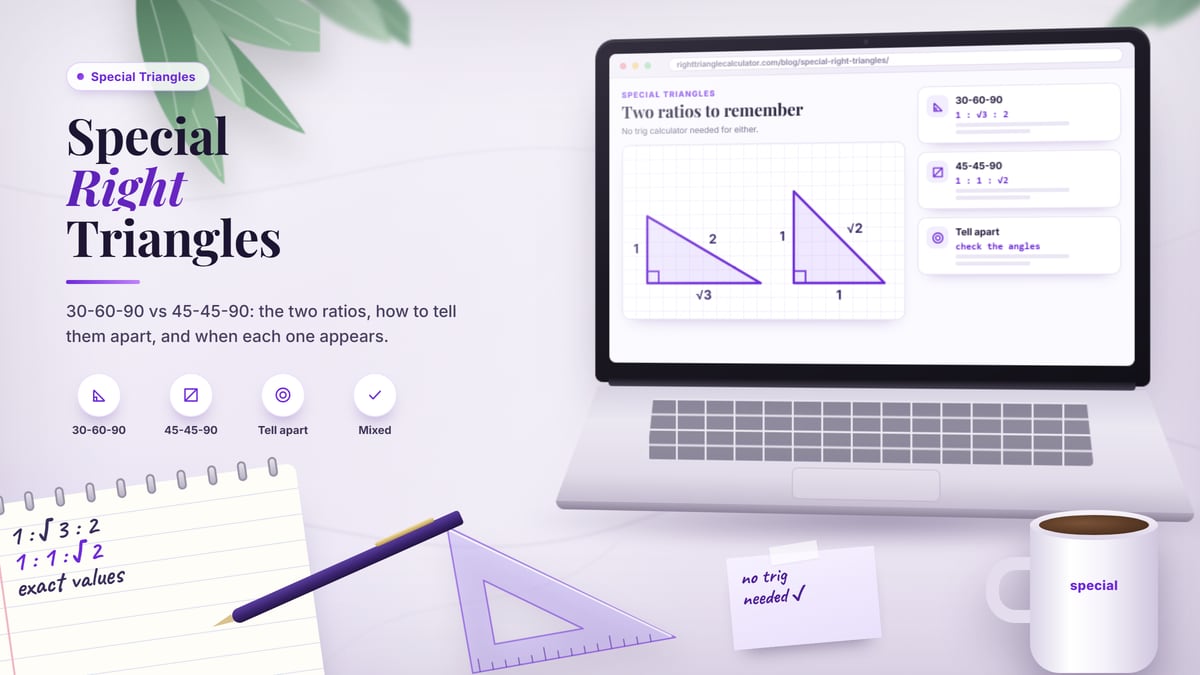
There are exactly two special right triangles : the 30-60-90, whose sides are always in the ratio 1 : √3 : 2, and the 45-45-90, whose sides are always in the ratio 1 : 1 : √2. Both are “special” for the same reason. Their angles are fixed, so their side ratios are fixed too, which means a single known length hands you the entire triangle without a trig calculator. This page compares the two, shows how to tell at a glance which one you are holding, and works through problems that use both at once.
Figure 1
Figure 2
Put the two figures side by side and the difference is obvious: the 30-60-90 is visibly lopsided, with one leg about 1.73 times the other, while the 45-45-90 is symmetric about its own diagonal.
What makes a right triangle “special”
A right triangle has three angles and three sides, and normally you need three pieces of information to pin it down. Special right triangles cheat that requirement because two of their angles are already known.
Fix the three angles of any triangle and you fix its shape. Every triangle with angles 30°, 60° and 90° is similar to every other triangle with those angles, so all of them share one set of side ratios. The same is true for 45°, 45° and 90°. That gives three practical consequences:
- One measurement determines the whole triangle. Give me any single side of a 30-60-90 and I can produce the other two by multiplying or dividing. The same holds for a 45-45-90.
- No calculator is needed. You never type
sin 30into anything. The ratio does the work, and the answer comes out in exact radical form rather than as a decimal approximation. - The answers stay exact.
7√3is an exact length.12.12is a rounded one. Special triangles let you carry exact values through several steps and round only at the very end.
Ordinary right triangles have none of this. A triangle with legs 4 and 9 needs the Pythagorean theorem for the hypotenuse and an inverse tangent for the angles. These two shapes skip both steps.
The two triangles side by side
Here is the core comparison in one place.
| Triangle | Angles | Side Ratio | Key Relationship |
|---|---|---|---|
| 30-60-90 | 30°, 60°, 90° | 1 : √3 : 2 | Hypotenuse is exactly twice the short leg; long leg is the short leg times √3 |
| 45-45-90 | 45°, 45°, 90° | 1 : 1 : √2 | The two legs are equal; the hypotenuse is a leg times √2 |
That table covers the ratios. The next one covers everything else you might actually be asked about, written in terms of the short side a (for the 30-60-90 that is the leg opposite 30°, for the 45-45-90 it is either leg, since both are the shortest).
| Property | 30-60-90 | 45-45-90 |
|---|---|---|
| Hypotenuse from the short side | c = 2a | c = a√2 ≈ 1.4142a |
| Other leg from the short side | b = a√3 ≈ 1.7321a | b = a |
| Area in terms of the short side | (√3/2)a² ≈ 0.8660a² | a²/2 = 0.5a² |
| Perimeter in terms of the short side | a(3 + √3) ≈ 4.7321a | a(2 + √2) ≈ 3.4142a |
| Is it isosceles? | No, all three sides differ | Yes, the two legs are equal |
| Lines of symmetry | 0 | 1, the altitude from the right angle |
| Where it comes from | Half an equilateral triangle, cut down the middle | Half a square, cut along its diagonal |
| Smallest whole-number version | None, √3 is irrational | None, √2 is irrational |
Two rows deserve a comment. Neither triangle has a whole-number version, unlike the Pythagorean triples such as 3-4-5 and 5-12-13 where every side is an integer; a special right triangle always carries a radical. And the symmetry row explains a lot of exam questions: folding a 45-45-90 along the altitude from the right angle maps one leg onto the other, which is why its two acute angles must be equal.
The 30-60-90 in brief
Take an equilateral triangle with sides of 2 and drop a perpendicular from one vertex to the opposite side. That perpendicular bisects both the 60° vertex angle and the base, leaving a right triangle with angles 30°, 60° and 90°, a hypotenuse of 2 (a full side of the original), and a short leg of 1 (half the base). Pythagoras supplies the third side: √(2² − 1²) = √3. That is the entire derivation of the 1 : √3 : 2 ratio.
Working from the short leg a, opposite the 30° angle.
The three sides are named by the angle each one faces:
- short leg
a, opposite 30° - long leg
b, opposite 60°, equal toa√3 - hypotenuse
c, opposite 90°, equal to2a
The most common route into a 30-60-90 is through the hypotenuse, because halving is easier than dividing by √3: find the short leg first with a = c/2, then get the long leg as a√3.
Problem 1 30-60-90 from the short leg
- Given
- A 30-60-90 triangle whose leg opposite the 30° angle is 7 cm
- Find
- The long leg and the hypotenuse
- Formula
- b = a√3, c = 2a
- Substitution
- b = 7√3, c = 2 à - 7
- Calculation
- b = 7 Ã - 1.7320508 = 12.1244, c = 14
Answer Long leg 7√3 ≈ 12.12 cm, hypotenuse 14 cm
Check it: 7² + (7√3)² = 49 + 147 = 196 = 14². The hypotenuse is the longest side, and 30° + 60° = 90°, so the triangle is consistent.
That is the shape of the rule, but not the whole story. Working backwards from the long leg means dividing by √3 and rationalising the result, which is where most errors happen, and there are altitude, equilateral-triangle and coordinate-geometry applications that deserve their own treatment. The full 30-60-90 triangle guide covers all of that with eight worked examples.
The 45-45-90 in brief
Draw a square of side 1 and cut it along a diagonal. Each half is a right triangle with two legs of 1 and a hypotenuse of √(1² + 1²) = √2. Because the two legs are equal the two acute angles are equal, and since they must sum to 90° each is 45°. That is the 1 : 1 : √2 ratio, and it is the reason the 45-45-90 is also called the isosceles right triangle.
Working between a leg a and the hypotenuse c of a 45-45-90 triangle.
Only two numbers exist in this triangle: the leg and the hypotenuse. Multiply a leg by √2 to get the hypotenuse; divide the hypotenuse by √2 to get a leg. The division is usually rewritten as multiplication by √2 and division by 2, so that no radical is left underneath: c/√2 = c√2/2.
Problem 2 45-45-90 from the hypotenuse
- Given
- A 45-45-90 triangle with hypotenuse 10 in
- Find
- The length of each leg
- Formula
- a = c/√2 = (c√2)/2
- Substitution
- a = (10 à - √2)/2
- Calculation
- a = 5√2 = 5 à - 1.4142136 = 7.0711
Answer Each leg is 5√2 ≈ 7.07 in
Check it: (5√2)² + (5√2)² = 50 + 50 = 100 = 10². Both legs are shorter than the hypotenuse, as required.
Squares, diagonals of rectangles that happen to be squares, and every 45° slope in a coordinate plane run on this ratio. For the area shortcuts, the diagonal-of-a-square applications and practice working in both directions, see the complete 45-45-90 triangle guide.
How to tell which one you are looking at
Most mistakes with special right triangles are identification mistakes, not arithmetic ones. There are three ways a problem can hand you the triangle, and each has a reliable test.
From the angles
The fastest route. You only ever need one acute angle, because the other is its complement.
- See 30° or 60° anywhere, plus a right angle: it is a 30-60-90.
- See 45° plus a right angle: it is a 45-45-90. A single 45° is enough, since the remaining angle must also be 45°.
- See any other acute angle, say 37° or 50°: it is neither, and you need SOHCAHTOA rather than a ratio.
From the side ratios
If you have two sides but no angles, divide the longer by the shorter and compare the result against four numbers.
| Ratio you compute | Decimal | What it means |
|---|---|---|
| hypotenuse ÷ shorter leg = 2 | 2.0000 | 30-60-90, shorter leg faces 30° |
| longer leg ÷ shorter leg = √3 | 1.7321 | 30-60-90, longer leg faces 60° |
| hypotenuse ÷ longer leg = 2/√3 | 1.1547 | 30-60-90 |
| hypotenuse ÷ leg = √2 | 1.4142 | 45-45-90 |
| leg ÷ leg = 1 | 1.0000 | 45-45-90 |
| anything else | not a match | An ordinary right triangle, use trig |
The single most useful line in that table is the first one. If the hypotenuse is exactly double one of the legs, the triangle is a 30-60-90 and that leg faces the 30° angle. No other right triangle has a side exactly half its hypotenuse.
From one side plus one angle
This is the normal exam setup, and the procedure is mechanical:
- Read the given acute angle. It tells you which triangle you have (30 or 60 versus 45).
- Decide what the given side is: short leg, long leg or hypotenuse. Match it to the angle it faces.
- Convert to the short side first. For a 30-60-90, halve the hypotenuse or divide the long leg by √3. For a 45-45-90, divide the hypotenuse by √2, or note that you already have a leg.
- Multiply the short side back out to get whatever is missing.
Routing everything through the short side keeps you from applying the wrong multiplier. It is one extra line of working and it removes most of the risk.
Problem 3 Identify from two sides
- Given
- A right triangle with hypotenuse 20 and one leg 10
- Find
- Which special triangle it is, and the third side
- Formula
- Compare the hypotenuse to the leg: 20 ÷ 10 = 2
- Substitution
- Ratio of 2 means 30-60-90 with short leg 10
- Calculation
- Long leg = 10√3 = 17.3205, and sinâ»Â¹(10/20) = 30°
Answer A 30-60-90 triangle; the third side is 10√3 ≈ 17.32
Problem 4 Identify from two equal legs
- Given
- A right triangle with legs 12 m and 12 m
- Find
- Which special triangle it is, and the hypotenuse
- Formula
- Equal legs mean an isosceles right triangle, so c = a√2
- Substitution
- c = 12√2
- Calculation
- c = 12 à - 1.4142136 = 16.9706, and tanâ»Â¹(12/12) = 45°
Answer A 45-45-90 triangle; the hypotenuse is 12√2 ≈ 16.97 m
Why these two generate the exact trig values
Every exact value of sine, cosine and tangent you are asked to memorise at 30°, 45° and 60° comes straight out of these two triangles. Read the ratios off Figures 1 and 2 and the table writes itself.
From the 30-60-90 with sides 1, √3, 2: the side opposite 30° is 1 and the hypotenuse is 2, so sin 30° = 1/2. From the 45-45-90 with sides 1, 1, √2 the opposite and adjacent sides are both 1, so tan 45° = 1.
| Angle | sin | cos | tan | From |
|---|---|---|---|---|
| 30° | 1/2 = 0.5 | √3/2 ≈ 0.8660 | 1/√3 = √3/3 ≈ 0.5774 | 30-60-90 |
| 45° | √2/2 ≈ 0.7071 | √2/2 ≈ 0.7071 | 1 | 45-45-90 |
| 60° | √3/2 ≈ 0.8660 | 1/2 = 0.5 | √3 ≈ 1.7321 | 30-60-90 |
Every decimal above was checked against Math.sin, Math.cos and Math.tan in degree-converted form and agrees to four places. Notice the symmetry: sin 30° equals cos 60° and sin 60° equals cos 30°, because 30° and 60° are complementary angles in the same triangle, so each one’s opposite side is the other one’s adjacent side. When a trig problem contains 30°, 45° or 60°, this table lets you answer in exact form instead of reaching for a calculator.
Mixed problems that use both triangles
The two shapes rarely appear alone in harder questions. A figure gets split into a 45-45-90 and a 30-60-90 sharing a side, or an observation is taken at 45° and again at 30°. These are the problems the individual guides cannot cover, because they need both ratios in the same working.
The method is always the same: find the shared side first, then run each ratio outward from it. The shared side is usually a leg of one triangle and a different kind of leg of the other, so name it carefully in both before you multiply anything.
Figure 3
Problem 5 Mixed: two triangles sharing a vertical side
- Given
- A vertical segment of 8 cm. On its right sits a 45-45-90 triangle with that segment as one leg. On its left sits a 30-60-90 triangle with that segment as the leg opposite its 60° angle.
- Find
- The hypotenuse of each triangle
- Formula
- 45-45-90: c = a√2. 30-60-90: short leg = b/√3, then hypotenuse = 2 à - short leg
- Substitution
- c₠= 8√2. short = 8/√3 = 8√3/3, c₂ = 16√3/3
- Calculation
- câ‚ = 8 Ã - 1.4142136 = 11.3137. short = 4.6188, câ‚‚ = 9.2376
Answer 45-45-90 hypotenuse 8√2 ≈ 11.31 cm; 30-60-90 hypotenuse 16√3/3 ≈ 9.24 cm
Check: short leg 4.6188 and long leg 8 give a hypotenuse of √(4.6188² + 8²) = 9.2376, matching. Note the counter-intuitive result. The 45-45-90 has the longer hypotenuse even though both triangles stand on the same 8 cm side, because in the 30-60-90 that 8 cm is the long leg rather than the short one, so the triangle scales down rather than up.
Problem 6 Mixed: a mast measured from two points
- Given
- From point A the angle of elevation to the top of a mast is 45°. From point B, 100 m further back on the same straight line, the elevation is 30°.
- Find
- The height of the mast
- Formula
- At 45° the horizontal distance equals the height h. At 30° the horizontal distance is h√3. So h√3 − h = 100
- Substitution
- h(√3 − 1) = 100
- Calculation
- h = 100/(√3 − 1) = 50(√3 + 1) = 50 à - 2.7320508 = 136.6025
Answer The mast is 50(√3 + 1) ≈ 136.60 m tall
Problem 6 is the classic reason to know both ratios. The 45° sighting says at once that the horizontal distance from A equals the height. The 30° sighting says the distance from B is the height times √3, because in a 30-60-90 the side adjacent to 30° is √3 times the side opposite it. Checking back: A is 136.6025 m from the base and B is 136.6025 à - √3 = 236.6025 m from it, a difference of exactly 100. More setups of this kind appear in the angle of elevation and depression guide.
Problem 7 Mixed: same hypotenuse, different area
- Given
- A 30-60-90 triangle and a 45-45-90 triangle each have a hypotenuse of 8 units
- Find
- Which has the larger area, and by how much
- Formula
- 30-60-90: legs are c/2 and (c/2)√3. 45-45-90: each leg is c/√2
- Substitution
- Area₠= ½ à - 4 à - 4√3 = 8√3. Area₂ = ½ à - (4√2)² = ½ à - 32
- Calculation
- Areaâ‚ = 8 Ã - 1.7320508 = 13.8564. Areaâ‚‚ = 16
Answer The 45-45-90 is larger: 16 square units against 8√3 ≈ 13.86, a difference of about 2.14
Problem 7 generalises: for a fixed hypotenuse the 45-45-90 always wins, and the area ratio is 16 ÷ 8√3 = 2/√3 ≈ 1.1547 whatever the hypotenuse happens to be. Among all right triangles with a given hypotenuse the isosceles one has the greatest area, and the 45-45-90 is exactly that triangle. To test any of these numerically, enter the two known sides into the right triangle calculator.
Common mistakes
Applying 1 : 1 : √2 to a 30-60-90
The most frequent error, and it comes from pattern-matching on “special triangle” rather than on the angles. You see 30-60-90, remember that special triangles involve a radical, reach for √2 and multiply. The result is wrong by a factor of √3/√2 ≈ 1.22, close enough to look plausible and far enough to fail. The fix is a one-second check before any multiplication: √2 belongs to equal legs, √3 belongs to unequal legs.
Assigning √3 to the wrong leg
In a 30-60-90 the √3 sits on the long leg, the one opposite 60°. Attaching it to the short leg produces a “short” leg that is longer than the long leg, which is geometrically impossible. The self-check is size order: in a 30-60-90 the three sides must come out in the order a < a√3 < 2a, that is roughly 1 < 1.73 < 2. If your long leg is smaller than your short leg, you assigned the multiplier backwards.
The related slip is dividing when you should multiply. Short leg to long leg multiplies by √3; long leg back to short leg divides by √3. Mixing the two directions changes your answer by a factor of 3.
Assuming any isosceles right triangle is 30-60-90
This one is backwards reasoning: 30-60-90 is the more famous triangle, so it gets applied by default. But a 30-60-90 has three different side lengths and zero lines of symmetry, so it is never isosceles. Equal legs force equal opposite angles, equal acute angles in a right triangle force 45° each, and so every isosceles right triangle is a 45-45-90 and nothing else.
Two smaller traps
- Treating a 3-4-5 as special. A 3-4-5 triangle has whole-number sides but its angles are about 36.87° and 53.13°, not 30 and 60. It is a Pythagorean triple, not a special right triangle. The 3-4-5 rule explains where that one is genuinely useful.
- Rounding √3 or √2 early. Multiplying by 1.73 instead of √3, then feeding that rounded figure into two more steps, drifts the answer. Carry the radical symbolically and convert to a decimal once, at the end.
Practice
Work these on paper first, leaving answers in exact radical form before converting.
- A 30-60-90 triangle has a hypotenuse of 18 cm. Find the short leg and the long leg.
- A 45-45-90 triangle has a leg of 15 mm. Find the hypotenuse.
- A right triangle has legs of 5 and 5√3. Identify the triangle, and give its hypotenuse and its two acute angles.
- A 45-45-90 triangle and a 30-60-90 triangle each have a hypotenuse of 14. Find the area of each, and say which is larger.
Answer key
- Short leg 9 cm, long leg 9√3 ≈ 15.59 cm. Halve the hypotenuse for the short leg, then multiply by √3. Check: 9² + (9√3)² = 81 + 243 = 324 = 18².
- Hypotenuse 15√2 ≈ 21.21 mm. A leg times √2. Check: 15² + 15² = 450, and √450 = 21.2132.
- A 30-60-90, hypotenuse 10, angles 30° and 60°. The ratio 5√3 ÷ 5 = √3 identifies it immediately. Check: 25 + 75 = 100, so the hypotenuse is exactly 10, and tanâ»Â¹(5 ÷ 5√3) = 30°.
- 45-45-90 area 49; 30-60-90 area 24.5√3 ≈ 42.44; the 45-45-90 is larger. Its legs are 14/√2 = 7√2 ≈ 9.899, giving ½ à - 98 = 49. The 30-60-90 has legs 7 and 7√3 ≈ 12.124, giving ½ à - 7 à - 7√3 = 42.4352. The ratio 49 ÷ 42.4352 = 1.1547 = 2/√3, matching Problem 7 exactly.
Frequently Asked Questions
How many special right triangles are there?
Two: the 30-60-90 and the 45-45-90. Those are the only right triangles whose acute angles are fixed at values producing clean exact side ratios, 1 : √3 : 2 and 1 : 1 : √2 respectively. Triangles like 3-4-5 and 5-12-13 are Pythagorean triples with integer sides but irregular angles, which is a different category entirely.
Is a 3-4-5 triangle a special right triangle?
No. A 3-4-5 triangle has whole-number sides, but its acute angles are approximately 36.87° and 53.13°, so it carries no fixed ratio you can apply to another triangle with different angles. Special right triangles are defined by their angles; Pythagorean triples are defined by their integer sides.
Which special right triangle should I use if I only know one side?
Neither one until you know an angle. A single side is compatible with both shapes and with infinitely many ordinary right triangles. You need one acute angle (30°, 45° or 60°) or a second side to fix the ratio, after which either the 30-60-90 rules or the 45-45-90 rules give you everything else.
Can a 30-60-90 triangle have all whole-number sides?
No. Its sides are in the ratio 1 : √3 : 2, and √3 is irrational, so if the short leg and the hypotenuse are whole numbers the long leg cannot be, and vice versa. The same argument rules out an all-integer 45-45-90, since √2 is irrational too. This is exactly what separates special right triangles from Pythagorean triples.
Why are these triangles worth memorising?
Because they remove the calculator from a large slice of geometry and trigonometry. They give the exact values of sin, cos and tan at 30°, 45° and 60°, they describe the diagonal of every square and the height of every equilateral triangle, and they turn multi-step problems into one multiplication. For triangles that are not special you can always solve the triangle numerically instead.