
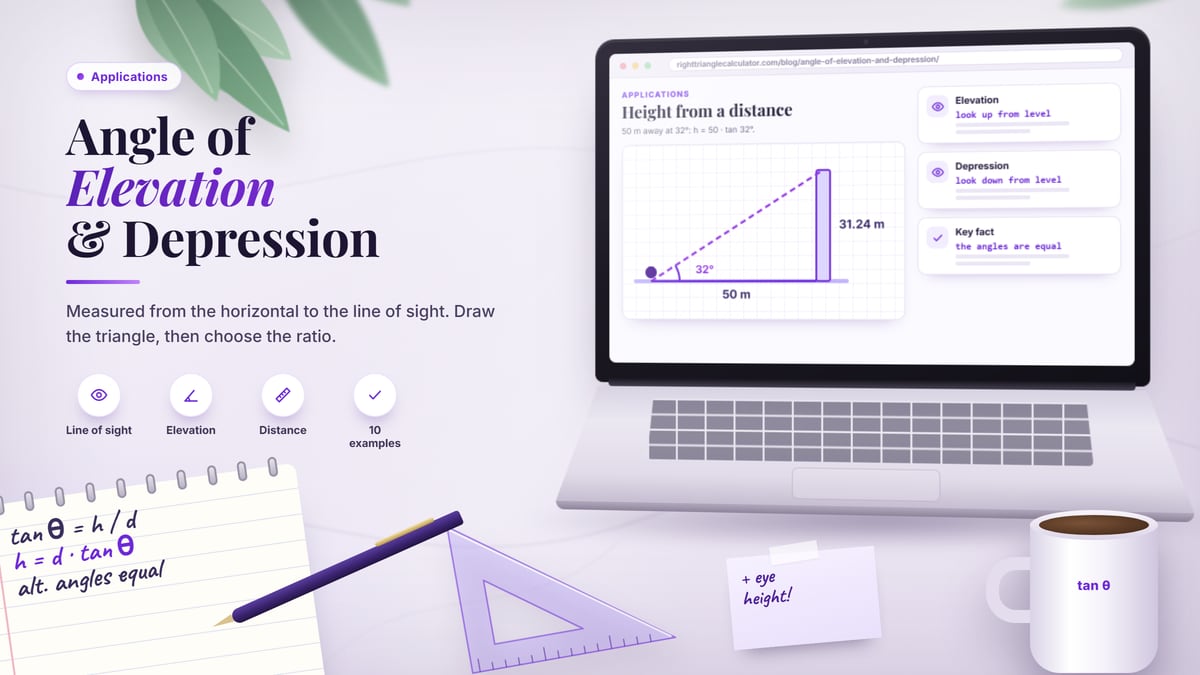
The angle of elevation is the angle measured upward from a horizontal line to your line of sight, and the angle of depression is the angle measured downward from a horizontal line to your line of sight. Both are always measured from the horizontal, never from the vertical, and both turn a described scene into a right triangle whose horizontal leg, vertical leg and hypotenuse you can solve with tangent, sine or cosine.
The two reference lines you must draw first
Every elevation or depression problem has exactly two lines meeting at the observer’s eye.
The horizontal reference line is a line through the observer’s eye, parallel to level ground. It is not the ground itself unless the observer’s eye happens to be at ground level. It exists only so the angle has something to be measured from, and on a diagram it is usually drawn as a dashed ray pointing towards the object.
The line of sight is the straight segment from the observer’s eye to the point being observed: the top of a tower, a boat on the water, a kite, the tip of a shadow. It is the hypotenuse of the triangle, always the longest of the three sides, and it is the side that sine and cosine reach.
The angle between these two lines is the angle of elevation when the sighted point is above the observer, and the angle of depression when the sighted point is below.
Figure 1
Figure 2
Notice where the angle sits in each picture. In Figure 1 it sits at the observer on the ground. In Figure 2 it sits at the top of the cliff, between the dashed horizontal and the downward line of sight. The angle of depression is never drawn inside the triangle at the bottom, because the horizontal it is measured from lies above the sighted point.
Elevation from A equals depression from B
This is the single fact that decides most exam questions, and it is where students lose the most marks.
The angle of elevation from A to B is equal to the angle of depression from B to A.
Here is why, stated properly. Put the observer’s eye at point A and the sighted point at B, with B above and to the right of A. Draw the horizontal ray through A pointing right, and draw a second horizontal ray through B pointing right. Both rays are horizontal, so they are parallel to each other. The line of sight AB cuts across both of them, so AB is a transversal of a pair of parallel lines.
The angle of elevation at A sits between A’s horizontal and the segment AB, opening upward on the upper side of the transversal. The angle of depression at B sits between B’s horizontal and the segment BA, opening downward on the lower side of the transversal. The two angles lie between the parallel lines and on opposite sides of the transversal, which makes them alternate interior angles. Alternate interior angles formed by a transversal cutting parallel lines are equal, so the two angles are equal.
Figure 3
Figure 4
Figures 3 and 4 are the same scene drawn twice, and because arctan(50.346 / 60) is 40° in both, the two marked angles are identical. That is the practical payoff: when a problem says “the angle of depression from the top of the lighthouse to the boat is 17°”, re-mark it as an angle of elevation of 17° at the boat, which drops it inside the triangle where tangent applies directly. You have only moved the label to a more convenient vertex.
Turning a described scene into a labelled triangle
Read the sentence once and assign each quantity to one of exactly three slots.
- The horizontal leg is the ground distance, measured along level ground from the observer to the point directly below or above the object. Words that signal it: “stands 42 m from the base”, “the boat is x metres from the foot of the cliff”, “the shadow is 9 m long”, “the horizontal distance to the runway”.
- The vertical leg is the height difference between the observer’s eye and the sighted point. Words that signal it: “the tower is 55 m tall”, “the aircraft is at 2400 m”, “the cliff is 85 m above sea level”.
- The hypotenuse is the line of sight itself. Words that signal it: “the kite string is 80 m long”, “the cable runs from the anchor to the top”, “the distance from the plane to the airport”.
The right angle is always at the foot of the vertical leg, where the object meets the ground, because a vertical object and level ground are perpendicular. Once you have marked that right angle, the scene is an ordinary right triangle and the naming rules from SOHCAHTOA take over.
Figure 5
Figure 5 is Figure 3 with the scenery removed. The angle of elevation sits at the bottom-right vertex, where the observer stands. Relative to that angle, the vertical height is the opposite side, the ground distance is the adjacent side, and the line of sight is the hypotenuse. Those three words are all you need to pick a ratio.
Choosing the trig ratio
Use tangent whenever the problem gives you or asks for the two legs, because tangent is the only ratio that ignores the hypotenuse. Reach for sine or cosine only when the line of sight is one of the quantities involved.
The three ratios, written in the language of elevation and depression problems.
| You know | You want | Ratio | Equation |
|---|---|---|---|
| distance + angle | height | tangent | h = d · tan(θ) |
| height + angle | distance | tangent | d = h / tan(θ) |
| height + distance | the angle | inverse tangent | θ = tanâ»Â¹(h / d) |
| line of sight + angle | height | sine | h = s · sin(θ) |
| line of sight + angle | distance | cosine | d = s · cos(θ) |
| height + angle | line of sight | sine | s = h / sin(θ) |
| distance + angle | line of sight | cosine | s = d / cos(θ) |
| height + line of sight | the angle | inverse sine | θ = sinâ»Â¹(h / s) |
The bottom two rows of the “find the angle” cases need inverse functions, which behave differently from the forward ones. If those are unfamiliar, work through finding an angle with inverse trig before attempting Problem 10 below.
Eye height: the correction almost everyone forgets
When a person measures an angle of elevation, the angle is measured at their eye, not at their feet. The horizontal reference line therefore sits at eye level, roughly 1.5 m to 1.7 m above the ground for an adult, and the triangle you solve has its horizontal leg at eye level too.
This means the vertical leg you calculate is not the height of the object. It is the height of the object above eye level. The full height is
Object height H from ground distance d, angle of elevation θ and eye height e.
Figure 6
Eye height is added only when the angle is genuinely measured from a raised eye. It is left out entirely in three common situations: when the instrument rests on the ground, when the problem says the angle is measured at ground level, and when there is no observer at all, as in a shadow problem where the sun’s rays strike the ground directly. Problems 1 and 8 below are deliberately eye-height-free for exactly that reason.
Eleven solved problems
Every result here was computed at full precision and rounded only at the last step. The stated precision appears in each answer.
Heights measured from ground level
Problem 1 Height of a building
- Given
- A clinometer resting on level ground 42 m from the base reads an angle of elevation of 38° to the roof
- Find
- Height of the building
- Formula
- h = d · tan(θ)
- Substitution
- h = 42 · tan(38°)
- Calculation
- h = 42 Ã - 0.7812856265 = 32.8139963...
Answer 32.8 m (107.7 ft), rounded to the nearest tenth of a metre
No eye height is added here. The instrument sits on the ground, so the horizontal reference line is the ground line and the vertical leg runs the full height of the building. Checking backwards, tanâ»Â¹(32.8139963 / 42) returns 38° exactly, and the hypotenuse of 53.29 m is longer than either leg, as it must be.
Problem 2 Height of a tower, eye level 1.6 m
- Given
- Observer's eye 1.6 m above the ground, standing 55 m from the tower, angle of elevation 27°
- Find
- Total height of the tower
- Formula
- H = d · tan(θ) + e
- Substitution
- H = 55 · tan(27°) + 1.6
- Calculation
- H = 28.0238997... + 1.6 = 29.6238997...
Answer 29.6 m (97.2 ft), rounded to the nearest tenth of a metre
The triangle gives 28.0 m, which is the height of the tower above eye level. Adding the 1.6 m of eye height lifts the answer to the true height. Drop the correction and you understate the tower by exactly 1.6 m, which is a 5.4 percent error on a structure this size.
Problem 3 Height of a tree
- Given
- Eye level 1.5 m, horizontal distance to the trunk 18 m, angle of elevation to the crown 41°
- Find
- Height of the tree
- Formula
- H = d · tan(θ) + e
- Substitution
- H = 18 · tan(41°) + 1.5
- Calculation
- H = 15.6471612... + 1.5 = 17.1471612...
Answer 17.1 m (56.3 ft), rounded to the nearest tenth of a metre
Foresters measure the horizontal distance to the trunk, not the slope distance, because only the horizontal one is the adjacent leg.
Working backwards to a distance
Problem 4 How far is the observer?
- Given
- A building is known to be 75 m tall; from a point at ground level the angle of elevation to the roof is 32°
- Find
- Horizontal distance from the observer to the base
- Formula
- d = h / tan(θ)
- Substitution
- d = 75 / tan(32°)
- Calculation
- d = 75 / 0.6248693519 = 120.0250896...
Answer 120.0 m (393.8 ft), rounded to the nearest tenth of a metre
When the unknown sits in the denominator, divide rather than multiply. A quick sanity check: 32° is less than 45°, so the height must be smaller than the distance, and 75 m is indeed smaller than 120.0 m.
Problem 5 Cliff and boat (angle of depression)
- Given
- An observer at a cliff edge 85 m above sea level sees a boat at an angle of depression of 24°
- Find
- Horizontal distance from the foot of the cliff to the boat
- Formula
- d = h / tan(θ)
- Substitution
- d = 85 / tan(24°)
- Calculation
- d = 85 / 0.4452286853 = 190.9131257...
Answer 190.9 m (626.4 ft), rounded to the nearest tenth of a metre
The 24° is marked at the cliff top, outside the triangle. Move it to the boat as an equal angle of elevation and it lands at the vertex where the height is opposite and the distance is adjacent, which is what makes the tangent equation work. Verifying, tanâ»Â¹(85 / 190.9131257) returns 24°.
Problem 6 Aircraft on approach
- Given
- An aircraft cruising at 2400 m sees the runway threshold at an angle of depression of 15°
- Find
- Ground distance and line-of-sight distance to the threshold
- Formula
- d = h / tan(θ) and s = h / sin(θ)
- Substitution
- d = 2400 / tan(15°), s = 2400 / sin(15°)
- Calculation
- d = 8956.9219... m, s = 9272.8879... m
Answer 8.96 km of ground distance (5.57 mi) and 9.27 km along the line of sight (5.76 mi), each rounded to the nearest 0.01 km
Two different ratios in one problem. Tangent reaches the ground distance because that is a leg, sine reaches the slant range because that is the hypotenuse. The two results are consistent: √(2400² + 8956.9219²) = 9272.8879 m, matching the sine result to the last digit carried.
Eye height, shadows and two angles
Problem 7 Flagpole with eye height
- Given
- Eye level 1.65 m, standing 12 m from a flagpole, angle of elevation to the finial 34°
- Find
- Height of the flagpole
- Formula
- H = d · tan(θ) + e
- Substitution
- H = 12 · tan(34°) + 1.65
- Calculation
- H = 8.0941022... + 1.65 = 9.7441022...
Answer 9.7 m (32.0 ft), rounded to the nearest tenth of a metre
Here the eye height is more than 20 percent of the triangle’s vertical leg of 8.1 m. On short objects measured from close range the correction matters far more than it does on a skyscraper, which is the opposite of what most people assume.
Problem 8 Shadow and the sun's angle
- Given
- A vertical pole 6 m tall on level ground, with the sun at an angle of elevation of 58°
- Find
- Length of the pole's shadow
- Formula
- L = h / tan(θ)
- Substitution
- L = 6 / tan(58°)
- Calculation
- L = 6 / 1.6003345290 = 3.7492161...
Answer 3.7 m (12.3 ft), rounded to the nearest tenth of a metre
No eye height appears anywhere in a shadow problem. The sun’s rays reach the ground directly, the pole starts at the ground, and the tip of the shadow is a point on the ground, so the triangle sits flat on the ground line with nothing floating above it. Note that the higher the sun climbs, the shorter the shadow: at 58° the shadow is well under the pole’s height.
Problem 9 Two angles from two positions
- Given
- From a point on level ground the angle of elevation to a tower top is 30°; after walking 40 m directly towards the tower it is 45°. All measurements at ground level
- Find
- Height of the tower
- Formula
- h = 40 / (cot 30° − cot 45°) = 40 / (√3 − 1)
- Substitution
- h = 40 / (1.7320508076 − 1)
- Calculation
- h = 40 / 0.7320508076 = 20(√3 + 1) = 54.6410161...
Answer 54.6 m (179.3 ft), rounded to the nearest tenth of a metre
Two observations, two triangles, one shared vertical leg. Write the two distances in terms of the same unknown height, h / tan(30°) and h / tan(45°), and subtract them: their difference is the 40 m walked. The exact value is 20(√3 + 1), and rationalising 40 / (√3 − 1) gives that form directly. Checking numerically, the far distance is 94.641 m and the near one is 54.641 m, differing by exactly 40 m. Problems of this shape appear constantly in right triangle word problems.
Finding the angle instead of a length
Problem 10 What is the angle of elevation?
- Given
- A 60 m building viewed from 100 m away, by an observer whose eye is 1.7 m above the ground
- Find
- Angle of elevation to the top of the building
- Formula
- θ = tanâ»Â¹((H − e) / d)
- Substitution
- θ = tanâ»Â¹((60 − 1.7) / 100)
- Calculation
- θ = tanâ»Â¹(0.583) = 30.2421853...
Answer 30.2°, rounded to the nearest tenth of a degree
Eye height is subtracted here rather than added, because the triangle only spans the part of the building that lies above eye level. Using the full 60 m would give 30.96°, overstating the angle by about 0.72°. Back-substituting, 100 · tan(30.2421853°) returns 58.3 m, which is 60 m minus the 1.7 m of eye height.
Problem 11 Kite on a taut string
- Given
- 80 m of kite string held taut at a hand height of 1.4 m, with the string making an angle of elevation of 55°
- Find
- Height of the kite above the ground and its horizontal distance from the flyer
- Formula
- h = s · sin(θ) + e and x = s · cos(θ)
- Substitution
- h = 80 · sin(55°) + 1.4, x = 80 · cos(55°)
- Calculation
- h = 65.5321635... + 1.4 = 66.9321635..., x = 45.8861149...
Answer 66.9 m high (219.6 ft) and 45.9 m horizontally, each rounded to the nearest tenth of a metre
The string is the line of sight, so this is a sine and cosine problem rather than a tangent one. The two legs check out against the hypotenuse: √(65.5321635² + 45.8861149²) = 80.000 m. You can confirm any of these triangles in seconds with the right triangle calculator by entering one side and one acute angle.
Common diagram mistakes
Measuring the angle of depression from the vertical
The horizontal is the reference, always. A student who measures the 24° of Problem 5 down from the vertical cliff face instead of across from the horizontal is really using 90° − 24° = 66°, and gets 85 / tan(66°) = 37.8 m instead of 190.9 m. The boat ends up five times closer than it really is. The tell is that a shallow depression angle means a distant object, so a small angle must produce a large distance.
Putting the angle of elevation at the top of the object
The angle of elevation belongs at the observer’s eye and nowhere else. Mark 38° at the roof of the building in Problem 1 and you have swapped which leg is opposite and which is adjacent: the calculation becomes h = 42 / tan(38°) = 53.8 m instead of the correct 32.8 m. If an answer is surprisingly large or small, check where you put the angle before checking your arithmetic.
Forgetting eye height
Problem 2 gives 28.0 m from the triangle and 29.6 m for the tower. Problem 7 gives 8.1 m from the triangle and 9.7 m for the flagpole. In both cases the triangle result is a real number that looks like a plausible answer, which is exactly why the error survives to the final line. Ask one question every time: is the horizontal reference line on the ground, or at eye level? If it is at eye level, the triangle stops at eye level too.
Using the wrong leg as adjacent
The adjacent leg is the one that runs along the horizontal reference line from the vertex where the angle sits. It is never the vertical object, and it is never the line of sight. If your “adjacent” side touches the right angle at the top rather than at the bottom, you have picked the wrong angle’s adjacent side.
Using slope distance as the horizontal leg
On sloping ground the distance you pace out is not the horizontal leg. Only the true horizontal projection is adjacent to the angle of elevation, which is why problems usually specify “horizontal distance”.
Practice questions
Work each one on paper, round only at the end, then check the key.
- A clinometer on the ground 64 m from a radio tower reads an angle of elevation of 29°. How tall is the tower?
- An observer with an eye height of 1.55 m stands 25 m from a tree and measures an angle of elevation of 47° to the top. How tall is the tree?
- From a lighthouse lamp 48 m above sea level, the angle of depression to a buoy is 17°. How far is the buoy from the base of the lighthouse?
- A wheelchair ramp rises 1.2 m over a horizontal run of 14 m. What is its angle of elevation?
- An aircraft at an altitude of 3200 m sees the airport at an angle of depression of 21°. Find both the ground distance and the line-of-sight distance.
- A 9 m pole casts a shadow 6.4 m long on level ground. What is the sun’s angle of elevation?
Answer key
- 35.5 m (116.4 ft), to the nearest tenth of a metre. h = 64 · tan(29°) = 35.4757792… No eye height, because the instrument is on the ground.
- 28.4 m (93.0 ft), to the nearest tenth of a metre. H = 25 · tan(47°) + 1.55 = 26.8092177… + 1.55 = 28.3592177… The triangle alone would give 26.8 m.
- 157.0 m (515.1 ft), to the nearest tenth of a metre. Re-mark the depression angle as a 17° elevation at the buoy, then d = 48 / tan(17°) = 157.0009256…
- 4.9°, to the nearest tenth of a degree. θ = tanâ»Â¹(1.2 / 14) = tanâ»Â¹(0.0857142857) = 4.8990924…
- 8.34 km on the ground and 8.93 km along the line of sight, each to the nearest 0.01 km. d = 3200 / tan(21°) = 8336.2850… m and s = 3200 / sin(21°) = 8929.3699… m.
- 54.6°, to the nearest tenth of a degree. θ = tanâ»Â¹(9 / 6.4) = tanâ»Â¹(1.40625) = 54.5829447…
If an answer is off, rebuild the diagram before rechecking the arithmetic, since nearly all errors in this topic are diagram errors. You can also check your result against the solver.
Frequently Asked Questions
Is the angle of elevation always equal to the angle of depression?
Yes, provided the two angles describe the same pair of points. The angle of elevation from A up to B equals the angle of depression from B down to A, because the horizontal through A and the horizontal through B are parallel and the line of sight is a transversal, making the two angles alternate interior angles. It is not true for two unrelated angles in the same picture, such as the elevation to a roof and the depression to a different object.
Do I have to add eye height to every answer?
No. Add it only when the angle is measured from a raised eye and the question asks for a height above the ground. If the instrument sits on the ground, if the question says the angle is taken at ground level, or if there is no observer at all, as in a shadow problem, the triangle already reaches the ground and adding anything would be wrong. When the observer is above the target instead, as in Problem 10, eye height is subtracted rather than added.
Which ratio should I use for elevation and depression problems?
Tangent, in most cases, because elevation and depression problems normally pair a vertical height with a horizontal ground distance, and those are the two legs. Switch to sine or cosine only when the line of sight itself appears, for example a taut kite string, a guy wire, or the slant range from an aircraft to a runway.
Can an angle of elevation be greater than 90 degrees?
No. The angle of elevation is one of the two acute angles of a right triangle, so it lies strictly between 0° and 90°. At exactly 90° the object would be directly overhead and there would be no horizontal leg at all; at 0° the line of sight would lie flat along the horizontal. The same bounds apply to the angle of depression.
What is the difference between the line of sight and the horizontal distance?
The line of sight is the slanted hypotenuse from the eye to the object, while the horizontal distance is the flat leg along the ground. The line of sight is always the longer of the two, and the gap grows as the angle steepens: at 15° the slant range exceeds the ground distance by about 3.5 percent, but at 60° it is double.