
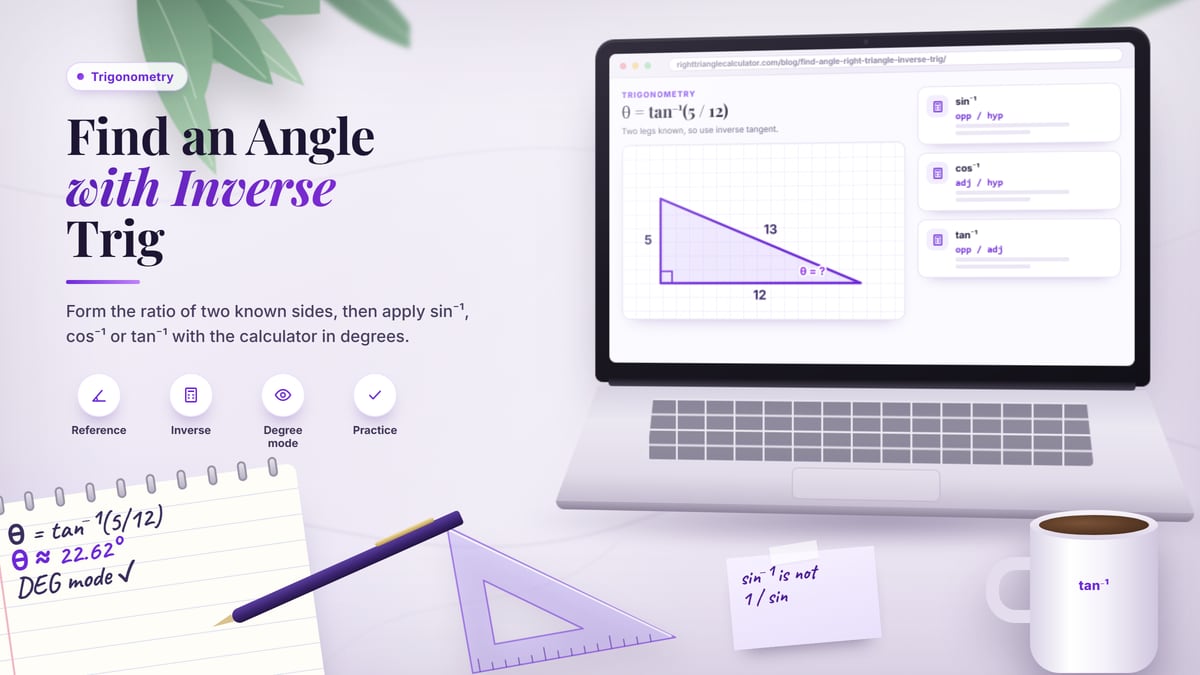
To find an acute angle of a right triangle from two known sides, divide those sides to form a ratio and apply the matching inverse function : θ = sinâ»Â¹(opposite / hypotenuse), θ = cosâ»Â¹(adjacent / hypotenuse), or θ = tanâ»Â¹(opposite / adjacent). The inverse takes the ratio in and hands the angle back, so the job is one division and one keystroke, with the calculator in degree mode.
The ratios, in two sentences
SOHCAHTOA says sin θ = opposite / hypotenuse, cos θ = adjacent / hypotenuse, and tan θ = opposite / adjacent, and you pick the ratio that names the two sides your problem mentions. If that needs unpacking, read SOHCAHTOA explained first, because everything below assumes you can name the three sides from a given angle.
The forward direction turns an angle into a ratio. This article runs the machine backwards.
The same input ratio, 0.6, produces three different angles depending on which inverse function you apply.
All three answers differ. An inverse is not a general-purpose “find the angle” button; it is tied to one specific ratio, and feeding a ratio to the wrong inverse produces a plausible-looking angle that is simply wrong.
Step 1: choose a reference angle and name the sides
Decide which acute angle you are solving for before any division happens, because opposite and adjacent swap places when you move between them. Mark your angle θ on the diagram, then label the sides relative to it:
- The hypotenuse faces the right angle, is the longest side, and never changes name.
- The opposite side faces θ across the triangle without touching it.
- The adjacent side touches θ and is not the hypotenuse.
Figure 1
The three ratios for Figure 1 are 5/13 ≈ 0.384615, 12/13 ≈ 0.923077 and 5/12 ≈ 0.416667, and all three inverses return the same angle:
Three routes to the same angle in the 5-12-13 triangle, verified to five decimal places.
That agreement is a self-check: if two disagree, you have mislabelled a side. Most problems give only two sides, so only one inverse is available.
Step 2: the decision table
Divide the two sides you know, in the order the ratio names them, and apply the matching inverse. There are exactly three cases.
| Two sides you know | Ratio | Inverse function |
|---|---|---|
| Opposite and hypotenuse | opposite / hypotenuse | θ = sinâ»Â¹(opposite / hypotenuse) |
| Adjacent and hypotenuse | adjacent / hypotenuse | θ = cosâ»Â¹(adjacent / hypotenuse) |
| Opposite and adjacent (the two legs) | opposite / adjacent | θ = tanâ»Â¹(opposite / adjacent) |
Read the table by asking one question: is the hypotenuse one of my two sides? If not, the answer is tangent, every time. If it is, the other side decides between sine (opposite) and cosine (adjacent).
The order inside the fraction matters as much as the choice of function. tanâ»Â¹(5/12) = 22.62° but tanâ»Â¹(12/5) = 67.38°, and only one of those is the angle you marked as θ. Write the opposite side on top, always, and the order takes care of itself.
The three inverse functions
Each inverse undoes exactly one ratio. On a calculator they sit above the sin, cos and tan keys, reached with SHIFT, 2nd or INV.
Inverse sine: sinâ»Â¹, also written arcsin
Use sinâ»Â¹ when your two known sides are the opposite side and the hypotenuse. It answers “which angle has this sine?”
Two notations for the same function. Textbooks prefer arcsin; calculators print sinâ»Â¹.
With opposite = 9 and hypotenuse = 14, the ratio is 9/14 = 0.642857 and sinâ»Â¹(0.642857) = 40.00520°, so θ ≈ 40.0° to one decimal place.
Inverse cosine: cosâ»Â¹, also written arccos
Use cosâ»Â¹ when your two known sides are the adjacent side and the hypotenuse.
Inverse cosine, in calculator notation and in textbook notation.
With adjacent = 6 and hypotenuse = 10, the ratio is 0.6 and cosâ»Â¹(0.6) = 53.13010°, so θ ≈ 53.1°.
Inverse tangent: tanâ»Â¹, also written arctan
Use tanâ»Â¹ when you know both legs and no hypotenuse. This is the commonest case in practice, because slopes, gradients, roof pitches and ramps are all quoted as a rise and a run.
Inverse tangent, the only one of the three that never mentions the hypotenuse.
With opposite = 8 and adjacent = 15, the ratio is 8/15 = 0.533333 and tanâ»Â¹(0.533333) = 28.07249°, so θ ≈ 28.1°. One structural difference: sine and cosine of an acute angle always land between 0 and 1, while tangent has no upper limit and tanâ»Â¹ accepts 0.05, 1, or 340 alike.
sinâ»Â¹(x) is the inverse sine, not 1 divided by sin(x)
The superscript −1 in sinâ»Â¹ is not an exponent. It means “the function that undoes sine”. Reciprocals of the trig functions have their own names, and none is written with a −1:
| Notation | Name | Meaning |
|---|---|---|
| sinâ»Â¹(x) | inverse sine, arcsine | the angle whose sine is x |
| 1 / sin(x) | cosecant, csc(x) | the reciprocal of sin x |
| cosâ»Â¹(x) | inverse cosine, arccosine | the angle whose cosine is x |
| 1 / cos(x) | secant, sec(x) | the reciprocal of cos x |
| tanâ»Â¹(x) | inverse tangent, arctangent | the angle whose tangent is x |
| 1 / tan(x) | cotangent, cot(x) | the reciprocal of tan x |
The two columns produce numbers that are not in the same universe. Take x = 0.5:
- sinâ»Â¹(0.5) = 30°. The angle whose sine is 0.5 is 30°. That is an angle in degrees, and it is the answer a triangle problem wants.
- 1 / sin(0.5°) = 114.59301. The cosecant of half a degree: a pure number with no units, over a hundred times bigger, and not an angle at all.
Two very different objects, one careless keystroke apart. The tell: an inverse takes a ratio in and gives an angle out, while a reciprocal takes an angle in and gives a ratio out. The genuine cosecant of 30° is csc(30°) = 1 / 0.5 = 2 exactly, and neither 2 nor 114.59301 can stand in for the 30° you wanted.
Degree mode versus radian mode
Mode errors do their worst damage here, because a wrong mode in the forward direction usually produces something obviously absurd, while in the inverse direction it produces a small tidy decimal that looks like it could be an answer.
| Mode | Display for tanâ»Â¹(8/15) | What it means |
|---|---|---|
| DEG | 28.07249 | 28.07 degrees |
| RAD | 0.489957 | 0.489957 radians, which is 28.07 degrees |
Converting back takes one multiplication: degrees = radians à - 180 / π, so 0.489957 à - 180 / π = 28.07249. A quick smell test: every acute angle lies between 0° and 90°, which is between 0 and about 1.5708 radians, so any inverse trig answer below 1.6 is a radian answer unless the angle really is a sliver under 1.6°.
Finding the second acute angle
Subtract the angle you have from 90°, because all three angles sum to 180° and one is already 90°. Take the triangle with legs 10 and 24 and hypotenuse 26, solving first for the angle opposite the leg of 10:
Subtraction route: one inverse calculation, then one subtraction.
The second route runs a fresh inverse from the other angle. From θ₂ the leg of 24 is opposite and the leg of 10 is adjacent, so tanâ»Â¹(24 / 10) = tanâ»Â¹(2.4) = 67.38014°, agreeing to five decimal places.
Figure 2
Subtraction wins on speed and safety: one inverse instead of two, so fewer keystrokes can go wrong, and no relabelling, which is where errors live. It also doubles as a check, since anything other than 90° for the sum means something upstream is wrong. One caveat: subtract the unrounded first angle, because starting from an already-rounded 22.6° gives 67.4° instead of 67.38014°.
The valid input range
sinâ»Â¹ and cosâ»Â¹ only accept ratios between −1 and 1, and in a right triangle the ratio is a quotient of two positive lengths, so the usable range is 0 to 1. That is not arbitrary: the hypotenuse is the longest side, so in opposite / hypotenuse and adjacent / hypotenuse the numerator is always smaller than the denominator. A ratio greater than 1 describes a triangle that cannot exist, so Math ERROR, Domain Error or NaN is not a calculator fault. It means the sides went into the fraction the wrong way round, or the wrong side was called the hypotenuse.
A worked example of the error. A triangle is described with a leg of 8 and a hypotenuse of 5, and a student writes sinâ»Â¹(8 / 5) = sinâ»Â¹(1.6), which errors. Two things are wrong. First, 8 cannot be a leg while 5 is the hypotenuse. Second, with the sides read correctly as opposite 5 and hypotenuse 8, the ratio is 5/8 = 0.625, giving sinâ»Â¹(0.625) = 38.68219° ≈ 38.7°. Check which side is longest before dividing.
Inverse tangent has no such guard rail. It accepts every real number, so tanâ»Â¹(15/8) = 61.92751° and tanâ»Â¹(8/15) = 28.07249° both compute cleanly even though only one answers your question.
Worked examples
Every angle below is rounded at the final step only.
Problem 1 Both legs known
- Given
- Legs of 8 and 15, θ is opposite the leg of 8
- Find
- θ
- Formula
- θ = tanâ»Â¹(opposite / adjacent)
- Substitution
- θ = tanâ»Â¹(8 / 15) = tanâ»Â¹(0.533333)
- Calculation
- θ = 28.07249°
Answer 28.1° (1 d.p.)
No hypotenuse is mentioned, so tangent it is, and since 8 is the shorter leg θ had to land below 45°. The other acute angle is 61.9°.
Problem 2 Opposite side and hypotenuse
- Given
- Opposite = 9, hypotenuse = 14
- Find
- θ
- Formula
- θ = sinâ»Â¹(opposite / hypotenuse)
- Substitution
- θ = sinâ»Â¹(9 / 14) = sinâ»Â¹(0.642857)
- Calculation
- θ = 40.00520°
Answer 40.0° (1 d.p.)
Check it in reverse: sin 40.00520° = 0.642857, and 0.642857 à - 14 = 9.000.
Problem 3 Adjacent side and hypotenuse
- Given
- Adjacent = 6, hypotenuse = 10
- Find
- θ
- Formula
- θ = cosâ»Â¹(adjacent / hypotenuse)
- Substitution
- θ = cosâ»Â¹(6 / 10) = cosâ»Â¹(0.6)
- Calculation
- θ = 53.13010°
Answer 53.13° (2 d.p.)
This is a 6-8-10 triangle, a scaled 3-4-5, so 53.13° is the familiar answer.
Problem 4 Hypotenuse and the leg touching the angle
- Given
- Hypotenuse = 29, adjacent leg = 20
- Find
- The angle between that leg and the hypotenuse
- Formula
- θ = cosâ»Â¹(adjacent / hypotenuse)
- Substitution
- θ = cosâ»Â¹(20 / 29) = cosâ»Â¹(0.689655)
- Calculation
- θ = 46.39718°
Answer 46.40° (2 d.p.)
The remaining leg is √441 = 21, and sinâ»Â¹(21 / 29) also returns 46.39718°, confirming it by a second route. The 20-21-29 triple is one of the families listed under Pythagorean triples.
From a diagram description
Problem 5 Read the angle off a labelled sketch
- Given
- A right triangle drawn with the right angle at the bottom-left, a vertical leg of 6 and a horizontal leg of 11
- Find
- The acute angle at the bottom-right vertex
- Formula
- θ = tanâ»Â¹(opposite / adjacent)
- Substitution
- θ = tanâ»Â¹(6 / 11) = tanâ»Â¹(0.545455)
- Calculation
- θ = 28.61046°
Answer 28.61° (2 d.p.)
The bottom-right vertex faces the vertical leg, so 6 is opposite and 11 is adjacent. The top-left angle is 90° − 28.61046° = 61.38954° ≈ 61.39°.
Figure 3
Problem 6 Angle at the top of a sketched triangle
- Given
- A right triangle with the right angle at the bottom-left, a vertical leg of 10 and a hypotenuse of 26 running from the top-left vertex to the bottom-right vertex
- Find
- The acute angle at the top-left vertex
- Formula
- θ = cosâ»Â¹(adjacent / hypotenuse)
- Substitution
- θ = cosâ»Â¹(10 / 26) = cosâ»Â¹(0.384615)
- Calculation
- θ = 67.38014°
Answer 67.38° (2 d.p.)
The vertical leg of 10 meets the hypotenuse at that vertex, so it is adjacent and cosine is right. Reaching for sine, sinâ»Â¹(10 / 26) = 22.62°, would have returned the angle at the other end of Figure 2.
Applied problems
Problem 7 Wheelchair ramp angle
- Given
- A ramp surface 18 m long rises 1.5 m
- Find
- The angle the ramp makes with the ground
- Formula
- θ = sinâ»Â¹(rise / ramp length)
- Substitution
- θ = sinâ»Â¹(1.5 / 18) = sinâ»Â¹(0.083333)
- Calculation
- θ = 4.78019°
Answer 4.78° (2 d.p.)
The ramp surface is the hypotenuse and the rise is opposite the angle at its foot, so inverse sine applies. A rise of 1.5 in 18 is a 1:12 gradient.
Problem 8 Ladder against a wall
- Given
- A 5 m ladder with its foot 2.1 m from the base of the wall
- Find
- The angle between the ladder and the ground
- Formula
- θ = cosâ»Â¹(base distance / ladder length)
- Substitution
- θ = cosâ»Â¹(2.1 / 5) = cosâ»Â¹(0.42)
- Calculation
- θ = 65.16541°
Answer 65.17° (2 d.p.)
The ladder is the hypotenuse and the ground distance is adjacent, so cosine is the ratio. It reaches √20.59 ≈ 4.54 m up the wall, and the angle between ladder and wall is 24.83459° ≈ 24.83°.
Figure 4
Problem 9 Roof pitch
- Given
- A roof rises 2.4 m over a horizontal run of 7.2 m
- Find
- The pitch angle
- Formula
- θ = tanâ»Â¹(rise / run)
- Substitution
- θ = tanâ»Â¹(2.4 / 7.2) = tanâ»Â¹(0.333333)
- Calculation
- θ = 18.43495°
Answer 18.4° (1 d.p.)
Rise and run are the two legs, so tangent handles it; the rafter would be √57.6 ≈ 7.59 m. Sight-line versions of the same calculation appear under angles of elevation and depression.
Find the missing side first
Problem 10 Angle from a leg and an area
- Given
- A right triangle with one leg of 9 cm and an area of 54 cm²
- Find
- The acute angle adjacent to the 9 cm leg
- Formula
- area = ½ à - legâ‚ Ã - legâ‚‚, then θ = tanâ»Â¹(opposite / adjacent)
- Substitution
- 54 = ½ à - 9 à - b, so b = 12; θ = tanâ»Â¹(12 / 9) = tanâ»Â¹(1.333333)
- Calculation
- θ = 53.13010°
Answer 53.13° (2 d.p.)
No ratio exists until the second leg does, so the area equation comes first. The triangle is 9-12-15, and the other acute angle is 36.86990° ≈ 36.87°.
Problem 11 Missing leg by Pythagoras, then the angle
- Given
- Hypotenuse = 17, one leg = 8
- Find
- The acute angle opposite the unknown leg
- Formula
- leg = √(c² − a²), then θ = sinâ»Â¹(opposite / hypotenuse)
- Substitution
- leg = √(17² − 8²) = √225 = 15; θ = sinâ»Â¹(15 / 17) = sinâ»Â¹(0.882353)
- Calculation
- θ = 61.92751°
Answer 61.93° (2 d.p.)
The shortcut cosâ»Â¹(8 / 17) gives the same 61.92751° in one step, but only once you notice the leg of 8 is adjacent to the angle you want. When that is not obvious, find the third side first, then solve the triangle to confirm both angles.
Rounding: do it last, and say what you did
Two rules cover almost every rounding question here. Keep the ratio at full calculator precision until the inverse has been applied, and state the precision of the final angle. The ratio needs protecting because inverse functions magnify small errors in their input. Take Problem 2, where the ratio is 9/14 = 0.642857142:
| What you feed sinâ»Â¹ | Result | Error against the true angle |
|---|---|---|
| 0.642857142 (full) | 40.00520° | none |
| 0.64 (2 d.p.) | 39.79182° | 0.21° low |
| 0.6 (1 d.p.) | 36.86990° | 3.14° low |
Rounding the ratio to two decimal places has already shifted the answer by a fifth of a degree, enough to fail a question asking for one decimal place, and one decimal place destroys it. Cosine behaves the same way: cosâ»Â¹(20/29) = 46.39718°, but a rounded 0.69 gives 46.36989°. Tangent is gentler, tanâ»Â¹(7/9) = 37.87498° against tanâ»Â¹(0.78) = 37.95423°, but gentler is not safe. Divide and press the inverse key in one unbroken sequence, so the rounded ratio never gets written down.
Common mistakes
Treating sinâ»Â¹ as 1/sin. sinâ»Â¹(0.5) = 30°, while 1 / sin(0.5°) = 114.59301. An inverse eats a ratio and returns an angle; a reciprocal eats an angle and returns a ratio.
Leaving the calculator in radian mode. An answer under 1.6 from an inverse key is almost certainly radians. Multiply by 180 and divide by π, then fix the mode.
Putting the sides in the wrong order. tanâ»Â¹(8/15) and tanâ»Â¹(15/8) are both valid, returning 28.07° and 61.93°, and the calculator cannot tell which one you meant. Write “opposite” and “adjacent” next to the actual numbers before dividing.
Picking the inverse for the wrong pair of sides. If the hypotenuse is not one of your two known sides, the answer is tanâ»Â¹. Using sinâ»Â¹ on two legs produces an angle belonging to no triangle in the problem.
Ignoring a domain error. A Math ERROR from sinâ»Â¹ or cosâ»Â¹ means the ratio exceeded 1, so the shorter side went on the bottom or a leg was called the hypotenuse. Re-read the side lengths rather than trying other functions.
Rounding the ratio before applying the inverse. Shown above: 0.64 in place of 0.642857 costs 0.21°.
Forgetting that the larger angle faces the longer side. It sits opposite that side, not beside it. In the 5-12-13 triangle the 67.38° angle faces the leg of 12.
Practice
Round to two decimal places unless told otherwise, and keep the ratio unrounded until the inverse is applied.
- Opposite side 7, hypotenuse 25. Find θ, then the other acute angle.
- The legs measure 20 and 21. Find the angle opposite the leg of 20.
- Adjacent side 15, hypotenuse 17. Find θ.
- A triangle is sketched with the right angle at the bottom-left, a vertical leg of 3.5 and a horizontal leg of 6. Find the acute angle at the bottom-right vertex.
- A loading ramp 11 m long rises 0.9 m. Find its angle to the ground, to one decimal place.
- Hypotenuse 41, one leg 9. Find the angle between that leg and the hypotenuse, and the third side.
- A right triangle has a leg of 5 cm and an area of 30 cm². Find the acute angle adjacent to that leg.
- A student’s display reads 0.63 after an inverse. What has gone wrong, and what is the angle in degrees?
Answer key
- 16.26° and 73.74°. Opposite with hypotenuse means sine: sinâ»Â¹(0.28) = 16.26020°, and 90° − 16.26020° = 73.73980°.
- 43.60°. Two legs means tangent: tanâ»Â¹(20 / 21) = tanâ»Â¹(0.952381) = 43.60282°. Since 20 is shorter than 21, the angle had to fall just below 45°.
- 28.07°. The known leg touches θ, so it is adjacent: cosâ»Â¹(0.882353) = 28.07249°. The third side is √64 = 8, and sinâ»Â¹(8 / 17) confirms it.
- 30.26°. That vertex faces the vertical leg, so 3.5 is opposite and 6 adjacent: tanâ»Â¹(0.583333) = 30.25644°.
- 4.7°. The ramp is the hypotenuse and the rise is opposite: sinâ»Â¹(0.081818) = 4.69308°.
- 77.32°, third side 40. The given leg is adjacent: cosâ»Â¹(0.219512) = 77.31962°. The third side is √1600 = 40, and tanâ»Â¹(40 / 9) agrees.
- 67.38°. Find the missing leg first: 30 = ½ à - 5 à - b gives b = 12, so tanâ»Â¹(12 / 5) = tanâ»Â¹(2.4) = 67.38014° in a 5-12-13 triangle.
- Radian mode; the angle is 36.10°. A reading of 0.63 sits inside the 0 to 1.5708 radian range, and 0.63 à - 180 / π = 36.09634°.
For a longer graded set, work through the right triangle trigonometry practice problems, and check your result against the calculator whenever an answer looks off.
Frequently Asked Questions
What is the formula to find an angle of a right triangle?
Use θ = sinâ»Â¹(opposite / hypotenuse), θ = cosâ»Â¹(adjacent / hypotenuse) or θ = tanâ»Â¹(opposite / adjacent), choosing the one that names the two sides you know. Form the ratio from those sides, then apply the inverse that matches it.
Does sinâ»Â¹(x) mean 1 divided by sin(x)?
No. sinâ»Â¹(x) is the inverse sine, the angle whose sine is x, and the −1 is function notation rather than an exponent. The reciprocal 1 / sin(x) is the cosecant, csc(x). For x = 0.5: sinâ»Â¹(0.5) = 30° while 1 / sin(0.5°) = 114.59301.
Can I find both acute angles with one calculation?
Yes. Find one angle with an inverse, then subtract it from 90° to get the other, because the two acute angles always sum to 90°. That is faster than a second inverse and avoids relabelling opposite and adjacent, which is where most errors creep in.
Why does my calculator say Math ERROR for sinâ»Â¹?
Because the ratio you entered was greater than 1, and no angle has a sine above 1. The hypotenuse is the longest side, so opposite / hypotenuse and adjacent / hypotenuse both land between 0 and 1. Check that you have identified the hypotenuse correctly and that the smaller number is on top.
Do I need degrees or radians?
Degrees, for almost all right triangle work, so set the calculator to DEG before you start. Radians are standard in calculus and physics, and the giveaway is the size of the answer: any inverse trig result below 1.6 is almost certainly radians.