
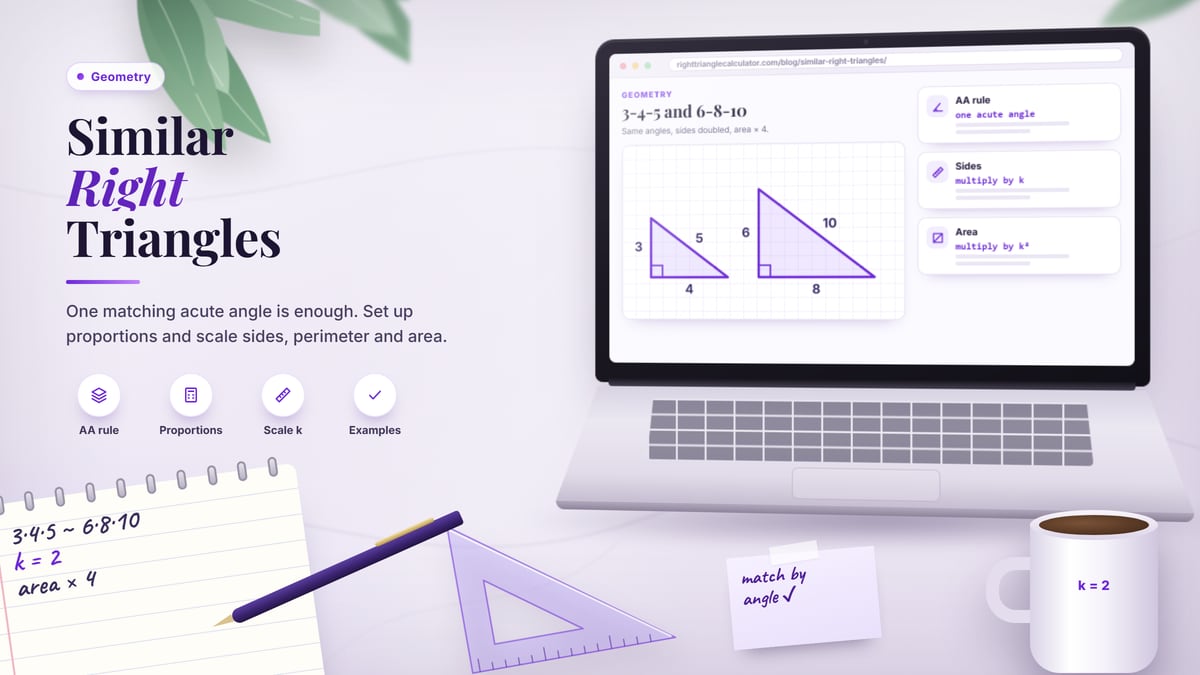
Two right triangles are similar when they share one pair of equal acute angles. That is the whole rule. The right angles already match by definition, so one matching acute angle gives you two pairs of equal angles, and because the three angles of any triangle sum to 180° the third pair is forced to match as well. This is AA similarity, and for right triangles it collapses to a single check: find one acute angle in each triangle that agrees, and the triangles are similar. Once they are similar, every pair of corresponding sides has the same ratio, and that ratio is the scale factor.
Figure 1
Figure 2
The 6-8-10 triangle is twice the size of the 3-4-5, yet the angles computed from its side lengths are identical: 36.87° and 53.13° in both. Doubling every length changed the size and nothing else.
AA similarity, stated precisely
AA similarity postulate: if two angles of one triangle are equal to two angles of another triangle, the triangles are similar.
That statement mentions no side lengths, and it does not need to. Angles fix shape. Once two angle pairs agree the third agrees automatically, because in both triangles you are subtracting the same two numbers from the same total of 180°.
Why one acute angle is enough for right triangles
In a general triangle you must verify two angle pairs. In a right triangle one of those pairs is free:
- Both triangles have a 90° angle. That is the first matching pair, and it costs nothing to check.
- Suppose one acute angle in each triangle measures 36.87°. That is the second matching pair.
- The remaining angle in each must be 180° − 90° − 36.87° = 53.13°. Third pair matches.
For right triangles, AA similarity reduces to a single acute-angle check.
So the working rule is: two right triangles are similar if and only if one acute angle of the first equals one acute angle of the second. The “only if” direction holds too. If the triangles are similar, corresponding angles are equal by definition, so such a pair exists.
Two other routes help when you are handed sides rather than angles:
- SSS similarity: all three side pairs share a common ratio. For right triangles you rarely need all three, since the third side follows from the Pythagorean theorem.
- SAS similarity: two side pairs share a ratio and the included angles are equal. The right angle sits between the two legs, so if the two legs are proportional, the triangles are similar. A 9-12 pair and a 3-4 pair both reduce to 3:4, so those triangles are similar without measuring a single angle.
What similarity preserves and what it does not
Similarity preserves exactly two things and destroys one.
Preserved: angles. A 36.87° angle stays 36.87° whether the triangle fits on a postage stamp or spans a football field.
Preserved: side ratios. The ratio of any two sides within one triangle equals the ratio of the corresponding two sides within the other. In the 3-4-5 triangle the short leg over the hypotenuse is 3/5 = 0.6; in the 6-8-10 triangle it is 6/10 = 0.6. This is why sine, cosine and tangent are well defined as functions of an angle alone, a point developed in the guide to SOHCAHTOA.
Not preserved: size. Lengths, perimeter and area all change. Similar is not congruent; congruent triangles are the special case where the scale factor equals 1.
Writing the similarity statement: vertex order carries the information
The symbol ~ means “is similar to”, but â–³ABC ~ â–³DEF says far more than that. The order of the letters declares the correspondence: A pairs with D, B with E, C with F. Every proportion you write afterwards reads straight off that order, so scrambling the letters makes every proportion wrong even when the triangles themselves are perfectly similar.
Take two concrete triangles:
- △ABC: right angle at C, angle A = 36.87°, angle B = 53.13°. Sides BC = 3, AC = 4, AB = 5.
- △DEF: right angle at F, angle D = 36.87°, angle E = 53.13°. Sides EF = 6, DF = 8, DE = 10.
| Statement | Pairing it declares | Verdict |
|---|---|---|
△ABC ~ △DEF | A↔D (36.87°↔36.87°), B↔E (53.13°↔53.13°), C↔F (90°↔90°) | Correct |
△ABC ~ △EDF | A↔E (36.87°↔53.13°), B↔D (53.13°↔36.87°), C↔F | Wrong |
Corresponding sides sit opposite corresponding angles, so BC (opposite A) pairs with EF, AC (opposite B) pairs with DF, and AB pairs with DE:
All three ratios agree, which confirms the correspondence in â–³ABC ~ â–³DEF.
The wrong statement claims BC pairs with DF and AC pairs with EF:
The ratios disagree, so â–³ABC ~ â–³EDF is a false statement about two genuinely similar triangles.
The triangles did not change. Only the claimed pairing changed, and that was enough to make the statement false.
Reading corresponding parts off a diagram
This routine works no matter how the triangles are rotated or flipped on the page:
- Mark the right angles. They always correspond to each other.
- Find the equal acute angles. Either they are marked, or you compute them from the sides with a tangent ratio, or the problem supplies them (a shared angle, parallel lines, vertical angles).
- Match sides by the angle they face, never by where they sit on the page. The side opposite the 36.87° angle in one triangle corresponds to the side opposite the 36.87° angle in the other, and the hypotenuse always corresponds to the hypotenuse.
Step 3 is the one people skip. “The bottom side goes with the bottom side” is not a rule; it holds only when both triangles happen to be drawn the same way up.
Setting up and solving proportions
Once the correspondence is fixed, a missing side is a one-line proportion. Put corresponding sides across from each other and keep the two triangles on consistent sides of the fraction bar.
The cross-multiplication step written out. Multiply each numerator by the opposite denominator, then divide.
Cross-multiplication is just multiplying both sides by both denominators at once. Starting from 3/6 = 4/x, multiply both sides by 6x: the left becomes 3x, the right becomes 24.
An equally valid set-up compares two sides within the same triangle:
Within-triangle ratios give the same answer. Pick one layout and stay with it.
Both layouts are correct. Mixing them halfway through is not, and it produces an inverted ratio. Pick a layout, write both fractions in it, then cross-multiply.
The scale factor k, and what it does to perimeter and area
The scale factor k is the single number that converts every length in the first triangle into the matching length in the second:
One factor for lengths, the same factor for perimeter, its square for area.
Perimeter is a sum of lengths, so multiplying each length by k multiplies the sum by k. Area is a length times a length, so it picks up k twice.
Worked demonstration: 3-4-5 against 6-8-10
| Quantity | 3-4-5 triangle | 6-8-10 triangle | Ratio |
|---|---|---|---|
| Short leg | 3 | 6 | 2 |
| Long leg | 4 | 8 | 2 |
| Hypotenuse | 5 | 10 | 2 |
| Perimeter | 3 + 4 + 5 = 12 | 6 + 8 + 10 = 24 | 2 = k |
| Area | ½ · 3 · 4 = 6 | ½ · 6 · 8 = 24 | 4 = k² |
| Acute angles | 36.87°, 53.13° | 36.87°, 53.13° | unchanged |
The perimeter went from 12 to 24, a factor of exactly k = 2. The area went from 6 to 24, a factor of exactly 4 = 2². Doubling the sides quadrupled the area, which is the most commonly misremembered fact in this topic. If a scaled copy has nine times the area, its sides are three times as long, not nine times.
Check it once more with k = 5. Scaling 3-4-5 by 5 gives 15-20-25, perimeter 15 + 20 + 25 = 60 = 12 à - 5, and area ½ · 15 · 20 = 150 = 6 à - 5².
A table of similar right triangle pairs
Every row below is a genuinely similar pair. The acute angles are identical down each row and differ between rows, which is why triangles from different rows are not similar to each other.
| Triangle 1 | Triangle 2 | Scale factor k | Shared acute angles |
|---|---|---|---|
| 3-4-5 | 6-8-10 | 2 | 36.87°, 53.13° |
| 3-4-5 | 15-20-25 | 5 | 36.87°, 53.13° |
| 5-12-13 | 15-36-39 | 3 | 22.62°, 67.38° |
| 5-12-13 | 12.5-30-32.5 | 2.5 | 22.62°, 67.38° |
| 8-15-17 | 24-45-51 | 3 | 28.07°, 61.93° |
| 7-24-25 | 14-48-50 | 2 | 16.26°, 73.74° |
| 1-1-√2 | 5-5-5√2 | 5 | 45°, 45° |
| 1-√3-2 | 4-4√3-8 | 4 | 30°, 60° |
A 3-4-5 and a 5-12-13 are both right triangles with whole-number sides, yet 36.87° ≠22.62°, so they are not similar and no proportion between them is valid. Confirm any row by entering the two leg lengths into the right triangle calculator and comparing the angles it returns.
Worked examples
Problem 1 Missing side from a proportion
- Given
- â–³ABC ~ â–³DEF with right angles at C and F. BC = 3, AC = 4, AB = 5, and EF = 9.
- Find
- DF and DE
- Formula
- BC / EF = AC / DF
- Substitution
- 3 / 9 = 4 / DF
- Calculation
- 3 · DF = 9 · 4 = 36, so DF = 12. Then k = 9/3 = 3, so DE = 5 à - 3 = 15.
Answer DF = 12, DE = 15
Check: 12² + 9² = 225 = 15², so 9-12-15 is 3-4-5 with every side tripled.
Problem 2 Finding the scale factor
- Given
- A right triangle with sides 5, 12, 13 is enlarged so the new hypotenuse is 32.5.
- Find
- The scale factor and the new leg lengths
- Formula
- k = new hypotenuse / old hypotenuse
- Substitution
- k = 32.5 / 13
- Calculation
- k = 2.5, so the legs become 5 Ã - 2.5 = 12.5 and 12 Ã - 2.5 = 30.
Answer k = 2.5; legs 12.5 and 30
Verification: 12.5² + 30² = 156.25 + 900 = 1056.25 = 32.5². The acute angles remain 22.62° and 67.38°, exactly as in the original 5-12-13 triangle.
Problem 3 Height of a tree from its shadow
- Given
- A person 1.7 m tall casts a shadow 2.4 m long. At the same moment a tree casts a shadow 18 m long.
- Find
- The height of the tree
- Formula
- tree height / tree shadow = person height / person shadow
- Substitution
- h / 18 = 1.7 / 2.4
- Calculation
- 2.4 · h = 1.7 à - 18 = 30.6, so h = 30.6 / 2.4
Answer 12.75 m
The sun’s rays arrive at the same angle for both objects, so the angle of elevation is shared, and both objects stand at a right angle to the ground. One matching acute angle is all AA needs. Sanity check: the tree’s shadow is 18 / 2.4 = 7.5 times the person’s, and 1.7 Ã - 7.5 = 12.75.
Problem 4 Flagpole height by the mirror method
- Given
- A mirror lies flat on level ground 4.5 m from the base of a flagpole. An observer whose eyes are 1.6 m above the ground stands 1.2 m from the mirror and sees the top of the pole in it.
- Find
- The height of the flagpole
- Formula
- pole height / pole-to-mirror distance = eye height / eye-to-mirror distance
- Substitution
- H / 4.5 = 1.6 / 1.2
- Calculation
- 1.2 · H = 1.6 à - 4.5 = 7.2, so H = 7.2 / 1.2
Answer 6 m
Light reflects at an equal angle to the mirror, so the angle at the observer’s feet equals the angle at the pole’s base, and both triangles stand at a right angle to the same flat ground. Check: 4.5 / 1.2 = 3.75, and 1.6 Ã - 3.75 = 6.
Problem 5 Are these two triangles similar?
- Given
- Triangle 1 has legs 5 and 12. Triangle 2 has legs 8 and 18. Both are right triangles.
- Find
- Whether the triangles are similar
- Formula
- Compare the leg ratios (SAS similarity with the included right angle)
- Substitution
- 5 / 12 ≈ 0.4167 versus 8 / 18 ≈ 0.4444
- Calculation
- The ratios differ. Angles: arctan(5/12) = 22.62°, arctan(8/18) = 23.96°.
Answer No, they are not similar
These triangles are close in shape, which is why eyeballing a diagram fails. A gap of 1.34° is invisible at textbook scale but fatal to any proportion you write.
Figure 3
Problem 6 Triangles drawn in different orientations
- Given
- â–³PQR has a right angle at Q, with PQ = 8, QR = 15 and PR = 17 (Figure 3). â–³STU is drawn rotated a quarter turn, has a right angle at T, angle S = angle P, and hypotenuse SU = 51.
- Find
- ST and TU
- Formula
- PQ / ST = PR / SU and QR / TU = PR / SU
- Substitution
- 8 / ST = 17 / 51 and 15 / TU = 17 / 51
- Calculation
- 17 · ST = 8 à - 51 = 408, so ST = 24. 17 · TU = 15 à - 51 = 765, so TU = 45.
Answer ST = 24, TU = 45
The rotation is a trap for the eye, not for the method. Angle S equals angle P and both triangles have a right angle, so AA gives △PQR ~ △STU, and the correspondence P↔S, Q↔T, R↔U comes from the letters, not the picture. Verification: 24² + 45² = 576 + 2025 = 2601 = 51², and k = 51/17 = 3 matches 24/8 and 45/15.
Problem 7 Perimeter and area under scaling
- Given
- A 3-4-5 triangle is enlarged by scale factor k = 2 to a 6-8-10 triangle.
- Find
- The new perimeter and the new area
- Formula
- Pâ‚‚ = k · Pâ‚ and Aâ‚‚ = k² · Aâ‚
- Substitution
- P₂ = 2 à - 12 and A₂ = 2² à - 6
- Calculation
- Pâ‚‚ = 24 and Aâ‚‚ = 4 Ã - 6 = 24
Answer Perimeter 24, area 24
Direct recomputation agrees: 6 + 8 + 10 = 24 and ½ · 6 · 8 = 24. Both landing on 24 is a coincidence of these numbers; perimeter and area scale by different powers of k.
Problem 8 Working backwards from an area
- Given
- A triangle similar to a 3-4-5 triangle has an area of 150 square metres. The 3-4-5 triangle has area 6.
- Find
- The scale factor, the side lengths and the perimeter
- Formula
- k² = Aâ‚‚ / Aâ‚, so k = √(Aâ‚‚ / Aâ‚)
- Substitution
- k = √(150 / 6) = √25
- Calculation
- k = 5, so the sides are 15 m, 20 m and 25 m, and the perimeter is 15 + 20 + 25.
Answer k = 5; sides 15 m, 20 m, 25 m; perimeter 60 m
Check: ½ · 15 · 20 = 150 square metres, and 15² + 20² = 225 + 400 = 625 = 25². Take the square root of the area ratio to get the length ratio. Using the area ratio itself would give k = 25 and sides of 75-100-125, an area 25 times too large.
The altitude case: one right triangle, three similar triangles
Drop a perpendicular from the right-angle vertex onto the hypotenuse and you create two smaller right triangles, both similar to each other and to the original. That is three similar triangles in one figure.
Figure 4
Name the parts precisely. In △ABC the right angle is at C, vertex A sits at the bottom-right of Figure 4 and vertex B at the top-left, with leg AC = 12, leg BC = 9 and hypotenuse AB = 15. Let D be the foot of the altitude from C, so CD ⊥ AB, with AD = 9.6 and DB = 5.4.
The correspondence, written out carefully
The three similar triangles created by the altitude to the hypotenuse, with vertices in matching order.
Read it one triangle at a time:
- △ADC ~ △ACB. Angle A is shared. Angle ADC = 90° corresponds to angle ACB = 90°, so angle ACD corresponds to angle ABC. Correspondence: A↔A, D↔C, C↔B.
- △CDB ~ △ACB. Angle B is shared. Angle CDB = 90° corresponds to angle ACB = 90°, and angle DCB = 90° − B = angle A. Correspondence: C↔A, D↔C, B↔B.
- â–³ADC ~ â–³CDB follows, since both are similar to the same triangle.
Numerically, for △ADC ~ △ACB: AD/AC = 9.6/12 = 0.8, DC/CB = 7.2/9 = 0.8 and AC/AB = 12/15 = 0.8, so k = 0.8 throughout. For △CDB ~ △ACB: CD/AC = 7.2/12 = 0.6, DB/CB = 5.4/9 = 0.6 and CB/AB = 9/15 = 0.6, so k = 0.6. Two scale factors, one shared shape: all three triangles have acute angles of 36.87° and 53.13°.
Problem 9 Finding an altitude by similarity
- Given
- A right triangle has legs 9 and 12 and hypotenuse 15. D is the foot of the altitude from the right angle onto the hypotenuse.
- Find
- AD and the altitude CD
- Formula
- From â–³ADC ~ â–³ACB: AD / AC = AC / AB
- Substitution
- AD / 12 = 12 / 15
- Calculation
- 15 · AD = 144, so AD = 9.6. Then CD = √(AC² − AD²) = √(144 − 92.16) = √51.84.
Answer AD = 9.6, CD = 7.2
Independent check: DB = 15 − 9.6 = 5.4, and 5.4² + 7.2² = 29.16 + 51.84 = 81 = 9², so △CDB closes correctly. The proportion AD/AC = AC/AB is a geometric mean relationship in disguise, proved in the article on the right triangle altitude theorem; for drills on those relationships, work through the geometric mean problems. This article stops at the similarity that makes them possible.
Common correspondence mistakes
Matching sides by position on the page
The most frequent error is pairing “the side along the bottom” with “the side along the bottom”. Position on the page is not a geometric property: rotate one triangle 90°, as in Problem 6, and every screen position changes while every angle stays put. Match each side to the side that faces the equal angle. Hypotenuse always pairs with hypotenuse, the one pairing that position never breaks.
Inverting the ratio
Having set up 3/9 = 4/x, it is easy to write the second fraction the other way round as 3/9 = x/4. Cross-multiplying gives 9x = 12 and x = 1.333, a larger triangle with a shorter side. Guard against it with a size check before the algebra: in Problem 1 the second triangle has 9 where the first had 3, so k = 3 and every answer must be three times its partner. An answer smaller than its partner means the fraction was flipped.
Assuming equal perimeters imply similarity
They do not. A 5-12-13 triangle has perimeter 30. A right triangle with legs 6 and 11.25 has hypotenuse √(36 + 126.5625) = √162.5625 = 12.75 and perimeter 6 + 11.25 + 12.75 = 30, the same total. But the acute angles are 22.62° and 67.38° for the first, 28.07° and 61.93° for the second, and the areas differ (30 against 33.75). Equal perimeters, equal areas and equal longest sides are all consistent with different shapes. Only equal angles, or a common ratio across corresponding sides, establishes similarity.
Assuming all right triangles are similar
A shared right angle is one matching pair of angles, and AA needs two. Compare the two most familiar right triangles:
| Triangle | Acute angles | Leg ratio |
|---|---|---|
| 3-4-5 | 36.87° and 53.13° | 3 : 4 = 0.75 |
| 45-45-90 | 45° and 45° | 1 : 1 = 1 |
36.87° ≠45° and 53.13° ≠45°, so these two triangles are not similar and never can be. No scale factor turns a 3-4-5 into an isosceles right triangle, because scaling cannot move an angle by 8.13°.
Figure 5
Figure 5 is similar to every other isosceles right triangle, whatever its size, and every 30-60-90 is similar to every other 30-60-90. Both families are set out in the guide to special right triangles. Across families, similarity fails.
Practice
Work these on paper, then check the side lengths and angles with the triangle solver on the homepage.
- â–³ABC ~ â–³XYZ with right angles at C and Z. AC = 6 and BC = 8, and XZ = 15. Find YZ and XY.
- A child 1.5 m tall casts a shadow 2 m long while a nearby building casts a shadow 46 m long. How tall is the building?
- Is a right triangle with legs 7 and 24 similar to a right triangle with legs 14 and 48? Justify with a ratio and an angle.
- A 5-12-13 triangle is scaled by k = 1.4. Find the new perimeter and the new area.
- A right triangle has legs 5 and 12 and hypotenuse 13. Use similarity to find the two segments the altitude from the right angle cuts on the hypotenuse.
Answer key
- YZ = 20, XY = 25. k = 15/6 = 2.5, so YZ = 8 à - 2.5 = 20. The first hypotenuse is √(6² + 8²) = 10, so XY = 25. Check: 15² + 20² = 625 = 25².
- 34.5 m. h/46 = 1.5/2, so 2h = 69 and h = 34.5. The shadow is 23 times longer, and 1.5 Ã - 23 = 34.5.
- Yes. 7/24 = 14/48 = 0.29167, and arctan(7/24) = arctan(14/48) = 16.26°. The hypotenuses are 25 and 50, so k = 2.
- Perimeter 42, area 58.8. The original perimeter is 30 and the original area is ½ · 5 · 12 = 30, so P = 30 à - 1.4 = 42 and A = 30 à - 1.96 = 58.8. Check on the scaled sides 7, 16.8, 18.2: 7 + 16.8 + 18.2 = 42 and ½ · 7 · 16.8 = 58.8.
- 25/13 ≈ 1.92 and 144/13 ≈ 11.08. Similarity gives (short segment)/5 = 5/13, so that segment is 25/13; the one next to the leg of 12 is 144/13. Check: 25/13 + 144/13 = 169/13 = 13. The altitude is 60/13 ≈ 4.62.
Frequently Asked Questions
Are all right triangles similar to each other?
No. Sharing a right angle gives only one matching pair, and AA similarity requires two. A 3-4-5 triangle has acute angles of 36.87° and 53.13°, while a 45-45-90 has two angles of 45°, so those two are not similar. Right triangles are similar only when an acute angle matches as well.
Is one pair of equal acute angles really enough?
Yes, for right triangles. The right angles supply the first matching pair for free, the acute angles supply the second, and the third follows because the angles sum to 180°. That satisfies AA completely, so no side measurement is needed.
Does the order of the letters in a similarity statement matter?
Yes. △ABC ~ △DEF declares that A corresponds to D, B to E and C to F, and every proportion is read from that order. For the triangles above, △ABC ~ △DEF is true while △ABC ~ △EDF is false, because the second pairs a 36.87° angle with a 53.13° angle.
If the sides double, does the area double?
No, the area quadruples. Lengths and perimeter scale by k, area scales by k². Doubling a 3-4-5 to 6-8-10 takes the perimeter from 12 to 24 but the area from 6 to 24. Working backwards, an area ratio of 9 means a length ratio of √9 = 3.
Are the two small triangles formed by the altitude similar to each other?
Yes, and to the original as well. With the right angle at C and the altitude foot at D on the hypotenuse, â–³ADC ~ â–³ACB ~ â–³CDB. All three share the same pair of acute angles; only the scale factors differ. In the 9-12-15 example the small triangles sit at k = 0.8 and k = 0.6.