
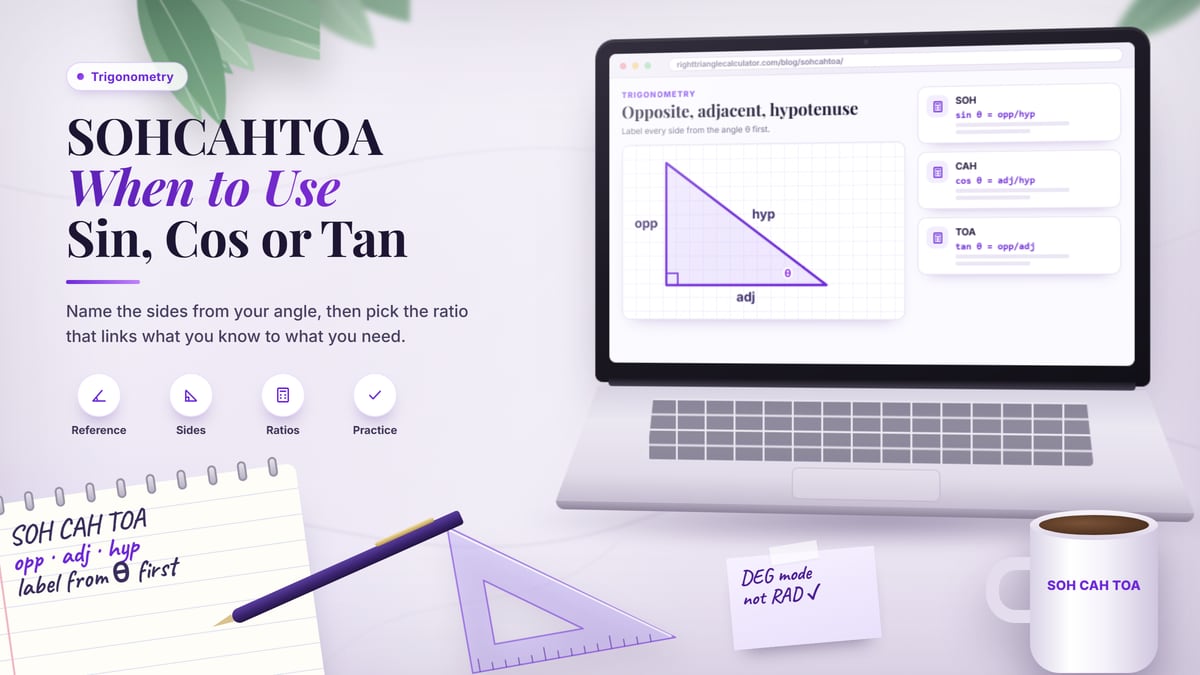
SOHCAHTOA is a three-part memory aid for the three trigonometric ratios in a right triangle: SOH means Sine is Opposite over Hypotenuse, CAH means Cosine is Adjacent over Hypotenuse, and TOA means Tangent is Opposite over Adjacent. Choose the ratio whose two named sides are the side you already know and the side you want, and everything else is arithmetic.
What SOHCAHTOA actually says
Written as equations, with θ standing for one of the two acute angles:
The three ratios packed into SOH, CAH and TOA.
Each ratio is a single number attached to a single angle. If θ is 35°, then sin 35° ≈ 0.5736 in every right triangle that contains a 35° angle, no matter how big or small that triangle is. That is the whole reason the ratios are useful: the shape of a right triangle is fixed by its acute angle, so one angle plus one side pins down every remaining measurement.
Three sides taken two at a time give three pairs, and SOHCAHTOA names exactly those three pairs:
- opposite and hypotenuse, handled by sine
- adjacent and hypotenuse, handled by cosine
- opposite and adjacent, handled by tangent
There is no fourth pair, so there is no fourth ratio to learn at this level. Every ratio problem in a right triangle is one of those three, and picking the right one is a matter of looking at which two sides are involved.
The reference angle decides everything
The words “opposite” and “adjacent” are not permanent names for particular sides. They are job titles that a side holds only while you are looking at one specific angle. That angle is called the reference angle, written θ here.
Pick one acute angle. Then:
- The hypotenuse is the side facing the right angle. It is the longest side, and it never changes when you switch reference angles.
- The opposite side is the one that does not touch θ at all. It sits across the triangle, facing θ.
- The adjacent side is the one that touches θ and is not the hypotenuse.
Figure 1
Notice that the right angle is never the reference angle. Both of the sides that meet at the right angle are legs, and the ratios are defined only for the two acute angles.
The same triangle, labelled from the first acute angle
Take a 3-4-5 triangle, with legs of 3 and 4 and a hypotenuse of 5. Its acute angles are about 36.87° and 53.13°, and those two do sum to 90°.
Stand at the smaller angle, θ ≈ 36.87°. The side of length 3 faces that angle without touching it, so 3 is the opposite. The side of length 4 touches the angle and is not the hypotenuse, so 4 is the adjacent.
Figure 2
From here, sin θ = 3/5 = 0.6, cos θ = 4/5 = 0.8, and tan θ = 3/4 = 0.75.
The same triangle, labelled from the other acute angle
Now move to the other acute angle, θ ≈ 53.13°, in the exact same triangle. Nothing about the triangle has changed, but two of the three labels have swapped. The side of length 4 now faces the reference angle, so 4 becomes the opposite. The side of length 3 now touches it, so 3 becomes the adjacent.
Figure 3
From this angle, sin θ = 4/5 = 0.8, cos θ = 3/5 = 0.6, and tan θ = 4/3 ≈ 1.3333.
Compare the two lists. The sine of one acute angle equals the cosine of the other, which is where the name “cosine” comes from (the sine of the complementary angle). The hypotenuse stayed 5 in both readings, because it is defined by the right angle and not by your choice of θ.
If you take one habit away from this article, take this one: write the letters O, A and H directly onto your diagram before you touch a calculator, and write them for the angle you are actually using.
Which ratio to use: the decision table
In a standard problem you are given one acute angle and one side, and asked for another side. Two sides are therefore involved: the one you know and the one you want. Find that pair in the table and the ratio is decided for you.
| Sides you know / want | Ratio to use | Rearranged formula |
|---|---|---|
| Know hypotenuse, want opposite | sin (SOH) | opposite = hypotenuse à - sin θ |
| Know hypotenuse, want adjacent | cos (CAH) | adjacent = hypotenuse à - cos θ |
| Know adjacent, want opposite | tan (TOA) | opposite = adjacent à - tan θ |
| Know opposite, want adjacent | tan (TOA) | adjacent = opposite / tan θ |
| Know opposite, want hypotenuse | sin (SOH) | hypotenuse = opposite / sin θ |
| Know adjacent, want hypotenuse | cos (CAH) | hypotenuse = adjacent / cos θ |
Those six rows cover every possible combination. Reading the table as three pairs rather than six rows is faster: if the hypotenuse is involved and the other side is opposite, use sine; if the hypotenuse is involved and the other side is adjacent, use cosine; if the hypotenuse is not involved at all, use tangent.
That last line is worth repeating on its own. Tangent is the only ratio that ignores the hypotenuse. So the moment you see a problem with two legs and no hypotenuse anywhere in it, you can stop deliberating and reach for tangent.
Solving for a missing side
Once the ratio is chosen, the algebra has only two shapes, and which one you get depends on where the unknown sits in the fraction.
Unknown in the numerator: multiply
Suppose θ and the hypotenuse are known and you want the opposite side. Start from the definition and multiply both sides by the hypotenuse:
The unknown starts on top, so you multiply.
The same single step works for adjacent = hypotenuse à - cos θ and for opposite = adjacent à - tan θ. In all three the unknown began as the numerator, and one multiplication finished the job.
Problem 1 Find the opposite side from the hypotenuse
- Given
- θ = 35°, hypotenuse = 20
- Find
- The side opposite θ
- Formula
- opposite = hypotenuse à - sin θ
- Substitution
- opposite = 20 à - sin 35°
- Calculation
- opposite = 20 Ã - 0.573576 = 11.47153
Answer 11.47 (2 d.p.)
Check it backwards: 11.47153 / 20 = 0.573576, and sinâ»Â¹(0.573576) returns 35°, so the answer is consistent with the input.
Problem 2 Find the adjacent side from the hypotenuse
- Given
- θ = 52°, hypotenuse = 9.4 cm
- Find
- The side adjacent to θ
- Formula
- adjacent = hypotenuse à - cos θ
- Substitution
- adjacent = 9.4 à - cos 52°
- Calculation
- adjacent = 9.4 Ã - 0.615661 = 5.78722
Answer 5.79 cm (2 d.p.)
The opposite side here would be 9.4 à - sin 52° ≈ 7.41 cm, and 5.79 is shorter than the hypotenuse of 9.4, as any leg must be.
Problem 3 Find the opposite side from the adjacent side
- Given
- θ = 28°, adjacent = 15
- Find
- The side opposite θ
- Formula
- opposite = adjacent à - tan θ
- Substitution
- opposite = 15 à - tan 28°
- Calculation
- opposite = 15 Ã - 0.531709 = 7.97564
Answer 7.98 (2 d.p.)
No hypotenuse appears anywhere in Problem 3, which is the signal for tangent. For the record the hypotenuse of that triangle is about 16.99, but you never needed it.
Unknown in the denominator: divide
Now suppose the unknown side is the one on the bottom of the fraction. You cannot finish in one multiplication, because the unknown is trapped under the division bar. Multiply both sides by the unknown first, then divide.
The unknown starts on the bottom, so it ends up dividing the known side.
The rule that falls out is short: if the unknown is on top, multiply by the ratio; if the unknown is on the bottom, divide the known side by the ratio. The same pattern gives hypotenuse = adjacent / cos θ and adjacent = opposite / tan θ.
Problem 4 Find the hypotenuse from the opposite side
- Given
- θ = 25°, opposite = 6 m
- Find
- The hypotenuse
- Formula
- hypotenuse = opposite / sin θ
- Substitution
- hypotenuse = 6 / sin 25°
- Calculation
- hypotenuse = 6 / 0.4226183 = 14.19721
Answer 14.20 m (2 d.p.)
Two sanity checks pass: 14.19721 à - sin 25° returns 6.0000, and 14.20 is larger than the leg of 6, as a hypotenuse must be. If you had multiplied by mistake you would have got 6 à - sin 25° ≈ 2.54, a “hypotenuse” shorter than one of its own legs, which is impossible.
Problem 5 Find the hypotenuse from the adjacent side
- Given
- θ = 63°, adjacent = 4.5
- Find
- The hypotenuse
- Formula
- hypotenuse = adjacent / cos θ
- Substitution
- hypotenuse = 4.5 / cos 63°
- Calculation
- hypotenuse = 4.5 / 0.4539905 = 9.91210
Answer 9.91 (2 d.p.)
Problem 6 Find the adjacent side from the opposite side
- Given
- θ = 40°, opposite = 12
- Find
- The side adjacent to θ
- Formula
- adjacent = opposite / tan θ
- Substitution
- adjacent = 12 / tan 40°
- Calculation
- adjacent = 12 / 0.8390996 = 14.30104
Answer 14.30 (2 d.p.)
Problem 6 is the case students get wrong most often. Because θ = 40° is less than 45°, the opposite side must be the shorter leg, so the adjacent side has to come out larger than 12. It does: 14.30. Multiplying instead would have produced 10.07, which points the wrong way. When you are unsure, solve the triangle with the calculator and compare.
Solving for a missing angle
If you know two sides and want the angle, you run SOHCAHTOA in reverse with the inverse functions sinâ»Â¹, cosâ»Â¹ and tanâ»Â¹ (often printed on a calculator as arcsin, arccos and arctan, or reached with a shift or second-function key).
Pick the inverse that matches the two sides you were given.
The ratio choice follows the same decision table. Two legs means tangent, a leg and the hypotenuse means sine or cosine depending on which leg it is.
Problem 7 Angle from opposite and hypotenuse
- Given
- opposite = 7, hypotenuse = 12
- Find
- θ
- Formula
- θ = sinâ»Â¹(opposite / hypotenuse)
- Substitution
- θ = sinâ»Â¹(7 / 12) = sinâ»Â¹(0.583333)
- Calculation
- θ = 35.68533°
Answer 35.7° (1 d.p.)
Problem 8 Angle from the two legs
- Given
- opposite = 9, adjacent = 5
- Find
- θ
- Formula
- θ = tanâ»Â¹(opposite / adjacent)
- Substitution
- θ = tanâ»Â¹(9 / 5) = tanâ»Â¹(1.8)
- Calculation
- θ = 60.94540°
Answer 60.9° (1 d.p.)
Since 9 is bigger than 5, the opposite side is the longer leg, so θ had to land above 45°. The other acute angle is 90° − 60.9° = 29.1°. That is as far as this article goes on inverse trig: the full method, including how to pick which inverse to use, how to read the calculator output and how to handle awkward ratios, is set out in the guide to finding an angle with inverse trig.
Exact values for 30°, 45° and 60°
Three angles come up often enough that their ratios are worth memorising in exact form. Keeping the radical instead of the decimal prevents rounding error from creeping through a multi-step problem.
| θ | sin θ | cos θ | tan θ |
|---|---|---|---|
| 30° | 1/2 = 0.5 | √3/2 ≈ 0.8660 | 1/√3 = √3/3 ≈ 0.5774 |
| 45° | √2/2 ≈ 0.7071 | √2/2 ≈ 0.7071 | 1 |
| 60° | √3/2 ≈ 0.8660 | 1/2 = 0.5 | √3 ≈ 1.7321 |
Read the table sideways and the complementary pattern shows up again: sin 30° equals cos 60°, and sin 60° equals cos 30°. Read the tangent column and you get a quick reasonableness test for any answer. Tangent is less than 1 below 45°, exactly 1 at 45°, and greater than 1 above 45°. Sine and cosine can never exceed 1, because a leg can never be longer than the hypotenuse, so a “sine” of 1.4 means an arithmetic slip somewhere.
These three angles are the ones built into the 30-60-90 and 45-45-90 special triangles, which is why their ratios come out as clean radicals rather than endless decimals.
More worked examples
The four problems below add the applied shapes you meet in homework and in the real world, where the triangle has to be drawn before any ratio can be chosen.
Problem 9 Ladder against a wall
- Given
- A 6.5 m ladder leans at 70° to the ground
- Find
- Height reached on the wall and distance of the foot from the wall
- Formula
- height = ladder à - sin θ, base = ladder à - cos θ
- Substitution
- height = 6.5 à - sin 70°, base = 6.5 à - cos 70°
- Calculation
- height = 6.5 Ã - 0.9396926 = 6.10800, base = 6.5 Ã - 0.3420201 = 2.22313
Answer 6.11 m up the wall, 2.22 m out from the wall (2 d.p.)
The ladder is the hypotenuse, because it faces the right angle formed by the wall and the ground. The 70° angle sits at the foot of the ladder, so the wall height is opposite it and the ground distance is adjacent to it.
Figure 4
Problem 10 Wheelchair ramp length
- Given
- A ramp must rise 1.2 m at an angle of 5° to the horizontal
- Find
- Length of the ramp surface
- Formula
- ramp = rise / sin θ
- Substitution
- ramp = 1.2 / sin 5°
- Calculation
- ramp = 1.2 / 0.0871557 = 13.76846
Answer 13.77 m (2 d.p.)
The rise is opposite the 5° angle and the ramp surface is the hypotenuse, so the unknown sits in the denominator and you divide. A shallow angle produces a long ramp, which is exactly why accessible ramps take up so much floor space.
Problem 11 Height of a tree from its shadow
- Given
- A tree casts an 18 m shadow when the sun is 31° above the horizon
- Find
- Height of the tree
- Formula
- height = shadow à - tan θ
- Substitution
- height = 18 à - tan 31°
- Calculation
- height = 18 Ã - 0.6008606 = 10.81549
Answer 10.82 m (2 d.p.)
No hypotenuse is mentioned and none is wanted, so tangent handles it in one step. Problems phrased in terms of a sight line from the ground upward, or from a height downward, are covered in detail under angles of elevation and depression.
Problem 12 Height of a kite
- Given
- 60 m of kite string, taut, at 48° to the ground
- Find
- Height of the kite above the hand holding the string
- Formula
- height = string à - sin θ
- Substitution
- height = 60 à - sin 48°
- Calculation
- height = 60 Ã - 0.7431448 = 44.58869
Answer 44.59 m (2 d.p.)
The string is the hypotenuse and the height is opposite the 48° angle, so this is a SOH problem with the unknown on top. The horizontal distance from the hand to the point below the kite would be 60 à - cos 48° ≈ 40.15 m.
Figure 5
Common mistakes
Labelling opposite and adjacent from the wrong angle. This is the number one source of wrong answers. A side that was opposite in part (a) of a question can be adjacent in part (b) if the reference angle moved. Re-label the diagram for every new angle rather than trusting the labels you wrote earlier.
Leaving the calculator in radian mode. sin 35° ≈ 0.5736 but sin(35 radians) ≈ −0.4282. A negative sine in a right triangle is impossible, since all three sides are positive lengths, so a negative result is a reliable sign that the mode is wrong. Gradians cause the same trouble more quietly, because the answers stay positive and merely come out wrong.
Using sine or cosine when the hypotenuse is not involved. If the problem gives you one leg and asks for the other, neither sine nor cosine can help directly, because both of them refer to the hypotenuse. Tangent is the ratio that connects two legs. Reaching for sine here usually means computing a hypotenuse you were never asked for and then doing a second, avoidable step.
Dividing when you should multiply, or the reverse. Look at where the unknown sits. On top means multiply; on the bottom means divide. Two quick checks catch the error: the hypotenuse must be the longest side, and the leg opposite the larger acute angle must be the longer leg. In Problem 6 the answer 14.30 passes both tests and the alternative 10.07 fails the second.
Rounding too early. In Problem 4 the exact working gives 6 / 0.42261826 = 14.1972. Rounding sin 25° to 0.42 first gives 6 / 0.42 = 14.2857, which is wrong in the first decimal place. Keep every digit your calculator holds until the final line, then round once and say what precision you used.
Assuming the hypotenuse is the vertical or the horizontal side. The hypotenuse is whichever side faces the right angle, and in a tilted diagram it may point in any direction. In the ladder problem the hypotenuse is the ladder, not the wall.
Practice
Work each of these on paper first, then check against the key. Round side lengths to 2 decimal places and angles to 1 decimal place.
- θ = 38°, hypotenuse = 14. Find the side opposite θ.
- θ = 62°, adjacent side = 7.5. Find the side opposite θ.
- θ = 21°, opposite side = 4.4. Find the hypotenuse.
- θ = 55°, hypotenuse = 26. Find the side adjacent to θ.
- θ = 33°, opposite side = 9. Find the side adjacent to θ.
- The two legs of a right triangle are 11 and 14. Find the acute angle opposite the side of length 11.
- A right triangle has a hypotenuse of 13 and one leg of 6. Find the acute angle between that leg and the hypotenuse.
- A playground slide is 3.5 m long and meets the ground at 40°. How high is the top of the slide above the ground?
Answer key
- 8.62. SOH with the unknown on top: 14 à - sin 38° = 14 à - 0.6156615 = 8.61926.
- 14.11. No hypotenuse, so TOA with the unknown on top: 7.5 à - tan 62° = 7.5 à - 1.8807265 = 14.10545.
- 12.28. SOH with the unknown on the bottom, so divide: 4.4 / sin 21° = 4.4 / 0.3583679 = 12.27788. The hypotenuse is longer than the leg of 4.4, as required.
- 14.91. CAH with the unknown on top: 26 à - cos 55° = 26 à - 0.5735764 = 14.91299.
- 13.86. TOA with the unknown on the bottom, so divide: 9 / tan 33° = 9 / 0.6494076 = 13.85879. Since 33° is below 45°, the adjacent leg must be the longer one, and it is.
- 38.2°. Two legs means tangent: tanâ»Â¹(11 / 14) = tanâ»Â¹(0.785714) = 38.15723°. The other acute angle is 51.8°.
- 62.5°. The given leg touches the angle, so it is the adjacent side: cosâ»Â¹(6 / 13) = cosâ»Â¹(0.461538) = 62.51357°. The third side is √(13² − 6²) = √133 ≈ 11.53, which is longer than 6, as the side opposite the larger acute angle must be.
- 2.25 m. The slide is the hypotenuse and the height is opposite the 40° angle: 3.5 à - sin 40° = 3.5 à - 0.6427876 = 2.24976.
For a longer set graded from single-step ratios up to multi-stage problems, work through the right triangle trigonometry practice set, and verify any answer you are unsure of before moving on.
Frequently Asked Questions
What does SOHCAHTOA stand for?
SOHCAHTOA stands for Sine equals Opposite over Hypotenuse, Cosine equals Adjacent over Hypotenuse, and Tangent equals Opposite over Adjacent. It is read as three groups of three letters, SOH, CAH and TOA, each one pairing a ratio name with the two sides that define it.
How do I know whether to use sine, cosine or tangent?
Look at which two sides the problem involves, the one you know and the one you want, and pick the ratio that names both. Opposite with hypotenuse is sine, adjacent with hypotenuse is cosine, and opposite with adjacent is tangent. If the hypotenuse is not mentioned at all, the answer is tangent every time.
Does the opposite side ever change?
Yes. Opposite and adjacent are defined relative to the reference angle, so they swap the moment you switch to the other acute angle of the same triangle. In the 3-4-5 triangle above, the side of length 3 is opposite the 36.87° angle and adjacent to the 53.13° angle. Only the hypotenuse keeps its name, because it is fixed by the right angle.
Can SOHCAHTOA be used on a triangle without a right angle?
No. The three ratios are defined using a hypotenuse and a right angle, so they apply only to right triangles. A triangle without a right angle needs the law of sines or the law of cosines instead, or you can split it into two right triangles by dropping an altitude and then apply SOHCAHTOA to each piece.
Do I multiply or divide when finding a missing side?
Multiply when the unknown side is the numerator of the ratio, and divide when it is the denominator. For example sin θ = opposite / hypotenuse rearranges to opposite = hypotenuse à - sin θ when the opposite side is unknown, and to hypotenuse = opposite / sin θ when the hypotenuse is unknown.